
Janice Domaratzki
Senior Portfolio Manager
June 9, 2026
Why You're Reading This
Money is emotional. Family is complicated. And when you put the two together in the context of estate planning, succession, and shared property, things can get messy fast.
If you've ever asked yourself any of these questions, this one is for you:
"What happens to the cottage when I'm gone?" "How do I make sure my kids from my first marriage are protected?" "My spouse and I own everything together, is that enough of a plan?" "My siblings and I inherited property and we can't agree on anything, what now?"
The truth is, most people don't have a plan. And the ones who do often have one that hasn't been looked at in years. This blog is about changing that, with straight talk, no jargon, and real information you can act on.
Financial literacy: The truth about family, money & what happens when you're gone
Succession Planning Isn't Just for Business Owners
When most people hear "succession planning," they think of family businesses and boardrooms. But succession planning applies to anyone who owns anything, a home, a cottage, an investment account, a life insurance policy, and has people in their life they care about.
At its core, succession planning is about deciding what happens to what you've built, and making sure the people you love aren't left fighting over it or paying more tax than necessary to keep it.
Here's the hard truth: if you don't have a plan, the government has one for you. And you probably won't like it.
Shared Property: More Complicated Than It Looks
Co-owning property, whether with a spouse, a sibling, or a parent, seems straightforward until it isn't.
There are two primary ways to own property jointly in Canada:
Joint Tenancy means both owners hold an equal, undivided interest in the property. If one owner dies, their share passes automatically to the surviving owner, regardless of what the will says. This is common between spouses, but it bypasses the estate entirely, which can have unintended tax and legal consequences.
Tenants in Common means each owner holds a distinct share of the property, which can be unequal. When one owner dies, their share goes through their estate and is distributed according to their will, or, if there is no will, according to provincial intestacy laws.
Why does this matter? Because many families assume that owning something jointly means everything is taken care of. It doesn't. Ownership structure determines what your will can and cannot control. Getting this wrong can cost your family time, money, and relationships.
The Cottage Conversation Nobody Wants to Have
The family cottage is one of the most emotionally charged assets in Canadian estate planning, and one of the most commonly mishandled.
Here's what most people don't know: when you die, the Canada Revenue Agency treats your cottage as if it was sold at fair market value on the day of your death. If that property has gone up in value since you bought it, and most have, your estate owes capital gains tax on that increase. At today's inclusion rates, that can be a significant bill.
Add to that the reality that your children may not all want the cottage equally. One wants to keep it. One needs the money. One lives across the country and hasn't visited in years. Suddenly, a place full of memories becomes a source of conflict.
The solution isn't to avoid the conversation. The solution is to have it now, with the right professionals, while you still have options, co-ownership agreements, trusts, life insurance to cover the tax liability, or a clear plan to sell and distribute proceeds fairly.
Blended Families: Love Doesn't Make It Simple
Canada's family landscape has changed. Second marriages, step-children, children from previous relationships, and common-law partnerships are the norm, not the exception. And yet most estate plans are written as if families are simple and linear. They're not.
In a blended family, the risks are real:
Your assets could unintentionally bypass your biological children entirely if your estate passes to your spouse and they later remarry or change their will.
Step-children have no automatic legal right to inherit in Canada, regardless of how long you've been a family. Without explicit instructions, they get nothing.
A surviving spouse from a second marriage and children from a first marriage can end up in direct legal conflict over your estate, a situation that's both expensive and devastating for family relationships.
There are planning tools designed specifically for these situations, spousal trusts, testamentary trusts, and carefully structured beneficiary designations, but they only work if they're put in place intentionally and reviewed regularly.

The Emotional Layer: Why Families Avoid This and Why That's a Mistake
Here's something that doesn't get said enough: most estate planning failures aren't legal failures. They're communication failures.
Families avoid these conversations because they're uncomfortable. Nobody wants to talk about death, or admit that they have a favourite child, or acknowledge that a second marriage changed things. So the hard conversations get deferred until it's too late to have them.
What gets left behind is a will that doesn't reflect reality, beneficiaries who feel blindsided, and siblings who stop speaking to each other over an asset that was supposed to represent a legacy.
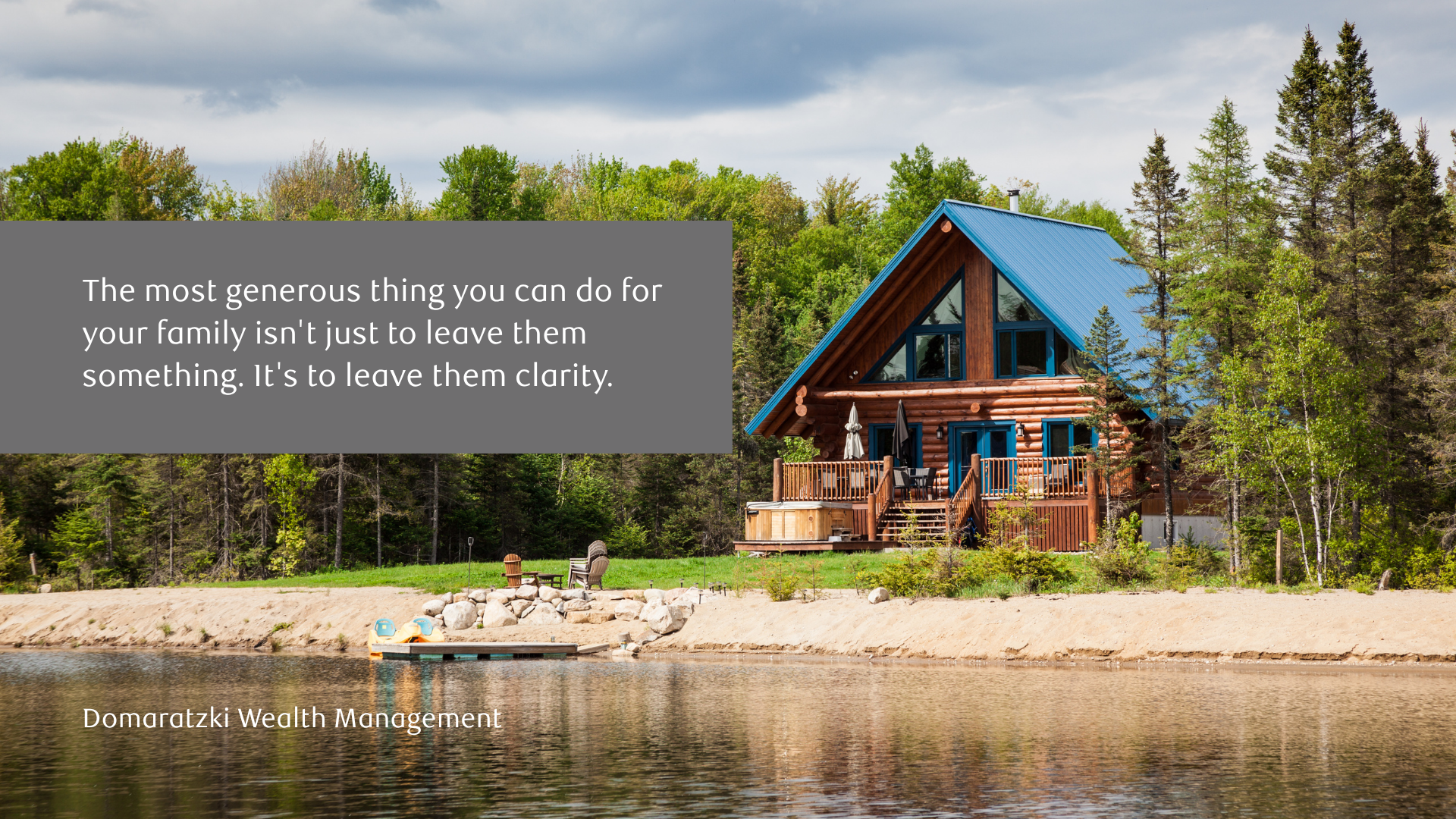
The most generous thing you can do for your family isn't just to leave them something. It's to leave them clarity.
That means having the conversations now. Documenting your intentions. Working with an advisor who will ask you the hard questions and help you build a plan that reflects your actual life, not the idealized version of it.
The Takeaway: A Plan Is an Act of Love
Estate planning, succession, shared property, blended families, none of it is easy. But leaving it undone is always harder on the people you leave behind than having the conversation now ever would have been on you.
The goal isn't a perfect plan. The goal is a real one, built around your actual family, your actual assets, and the life you're actually living.
If this blog raised questions you don't have answers to, that's exactly the point. Those questions deserve real answers, and you deserve a financial advisor who will give them to you straight.
Ready to have the conversation? Reach out so we can get started at 613-564-4840 or email me at janice.domaratzki@rbc.com.
Janice
Follow along on LinkedIn and Facebook, or reach out if you’d like to talk through your own situation or refer someone who could use support.
Janice Domaratzki, CIM │Senior Portfolio Manager & Investment Advisor, Domaratzki Wealth Management │ RBC Wealth Management │ RBC Dominion Securities Inc. │ T. 613-564-4840 │ T. 1-800-267-7680 │ 333 Preston Street, Suite 1100, Ottawa, Ontario K1S 5N4 │janice.domaratzki@rbc.com │Domaratzki Wealth Management website
RBC Wealth Management is a business segment of Royal Bank of Canada. For further information on the entities that are member companies of RBC Wealth Management, click here. The content in this publication is provided for general information only and is not intended to provide any advice or endorse/recommend the content contained in the publication.
® / ™ Trademark(s) of Royal Bank of Canada. Used under licence. © Royal Bank of Canada 2026. All rights reserved.