
Robin Gullason
Associate Portfolio Manager, Lead Strategist
September 10, 2026
Executive Summary
- After a quiet summer, stock markets have been a bit more uneasy as September gets underway.
- For reasons unknown (although theories abound!), September has a reputation of being the worst month for stocks.
- The data backs this up, as it is the only month that has on average delivered negative returns for both the TSX and S&P 500 going back to 1950.
- This is not as scary as it sounds, as the probability of experiencing a negative return in any individual September is little worse than a coin flip.
- This phenomenon tends to be short-lived, as both November and December are known for healthy returns and a high probability of a positive return.
- The fact that September has often been a more difficult month isn’t something to fear or even necessarily act on. It simply serves as a reminder that volatility is a fact of life for equity investors, and attempting to predict when it will appear is often futile.
Markets are not a fan of back to school…
The traditional “seasonal” effect on markets is well-known to long-time market practitioners. It may seem strange that different months have historically widely varied return outcomes but 75 years of data shows that is the case, and September holds the distinction of being negative on average for both the TSX and S&P 500.
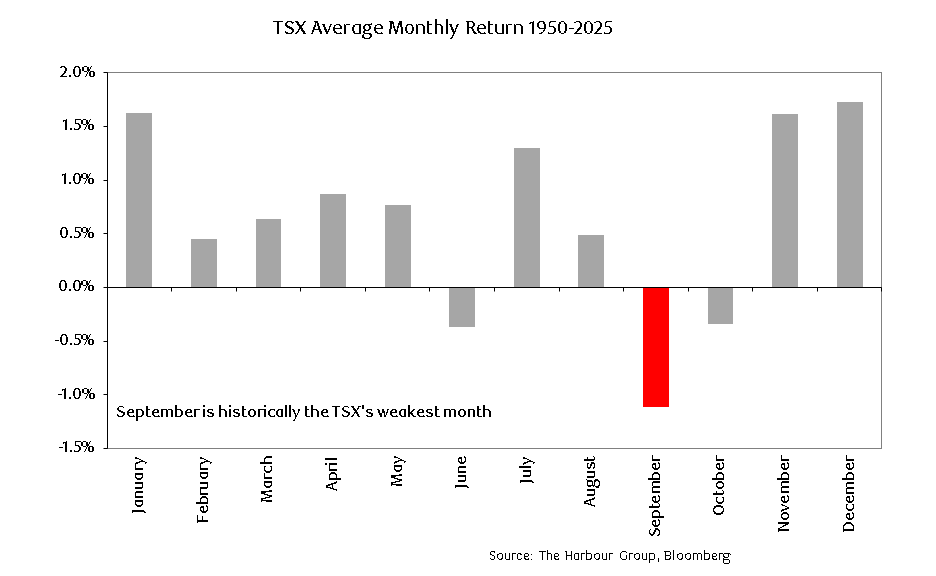
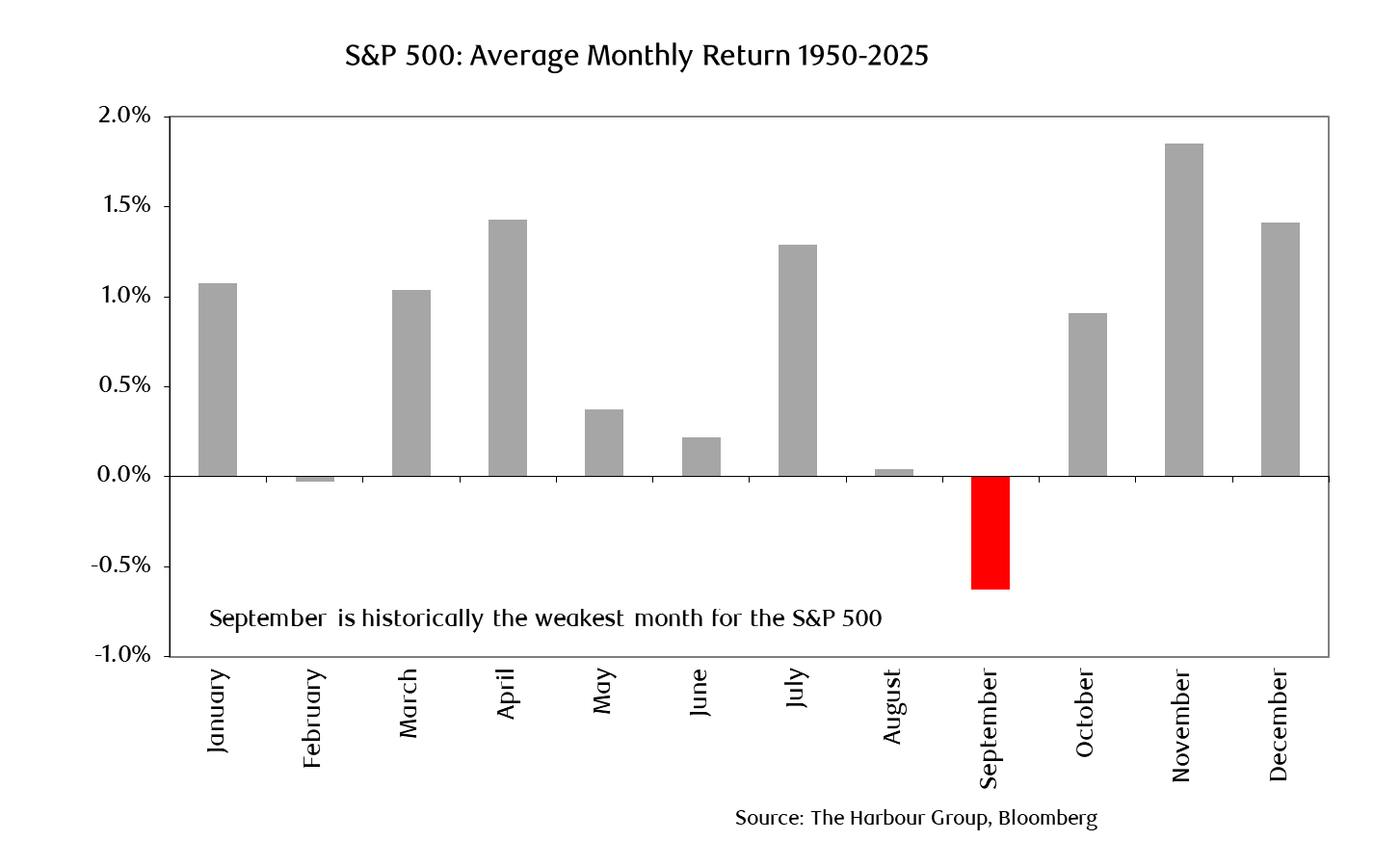
… but unlike students who just experienced months of freedom, the market has no excuse!
Everyone has their own theory as to why September is a challenging month for stocks. The most popular include a lack of corporate news after the summer earnings season, investors coming back from holiday and adjusting their portfolios, and the start of tax-loss selling season among others. Either way, this pattern has persisted for decades and while each of the above likely holds some kernel of truth, there is no concrete explanation other than the fact that we typically have one or two 5-10% corrections per year and they have to start somewhere.
Reality check – September returns are positive >40% of the time
While it is never fun to live through market volatility we need to put these numbers into perspective: the long term average is a 0.63% loss for the S&P 500 and a -1.1% decline for the TSX in September. For a portfolio split 50/50 between these two markets that adds up to an average decline of less than 1%, something that can happen in a single day. In our data set, the TSX has been positive in September 43% of the time and it is up 46% of the time south of the border – hardly a guaranteed loss.


Bumpy fall is typically followed by “the most wonderful time of the year”
As we have discussed previously, living with volatility is the price of admission for earning the equity market’s higher rates of return compared to bonds and cash. In an era of elevated price increases, after-inflation (aka “real”) returns matter once again. Everyone’s journey is different, but in our experience the more seasoned an investor is, the better they become at rolling with the punches, though it is never easy!
As fall turns to winter, the historical statistics turn sharply in investors’ favour. U.S. and Canadian equity markets have both seen strong and reliable performance in November and December, with these two months on average contributing more than 1/3 of the average annual return. What we would argue is even more interesting is that these two months are positive more than 2/3 the time in both markets – wonderful indeed!
So after all these facts and figures, what does it mean for investors? We think the title sums it up best. There may be some bumps in the road as the leaves turn but barring new and negative information on the state of the economy or prospects for earnings growth we think investors should stay the course. Fulfilling the promise of a financial plan isn’t about catching every rally and avoiding every pothole. Successful investors have a portfolio and asset allocation they are comfortable with regardless of what markets throw at us. The projections in a financial plan take into account episodes of market volatility but do not allow for major asset allocation shifts during these periods. We have yet to see a portfolio’s long-term returns impaired by staying the course in tough markets but we have seen multiple instances of long-term damage to portfolios that exit volatile markets and struggle to get back in.
The Harbour Group - 416-842-2300
Putting you first, every time, to help you navigate the complexities of managing your wealth. All of our team members, all of our resources, all of our collective insight: ALL FOR ONE: YOU™.
The information contained herein has been obtained from sources believed to be reliable at the time obtained but neither RBC Dominion Securities Inc. nor its employees, agents, or information suppliers can guarantee its accuracy or completeness. This report is not and under no circumstances is to be construed as an offer to sell or the solicitation of an offer to buy any securities. This report is furnished on the basis and understanding that neither RBC Dominion Securities Inc. nor its employees, agents, or information suppliers is to be under any responsibility or liability whatsoever in respect thereof. The inventories of RBC Dominion Securities Inc. may from time to time include securities mentioned herein. RBC Dominion Securities Inc. and its affiliates may have an investment banking or other relationship with some or all of the issuers mentioned herein and may trade in any of the securities mentioned herein either for their own account or the accounts of their customers. RBC Dominion Securities Inc. and its affiliates also may issue options on securities mentioned herein and may trade in options issued by others. Accordingly, RBC Dominion Securities Inc. or its affiliates may at any time have a long or short position in any such security or option thereon. Mutual funds are sold by RBC Dominion Securities Inc. There may be commissions, trailing commissions, management fees and expenses associated with mutual fund investments. Read the prospectus before investing. Mutual funds are not guaranteed, their values change frequently and past performance may not be repeated. RBC Dominion Securities Inc.* and Royal Bank of Canada are separate corporate entities which are affiliated. *Member CIPF. ®Registered Trademark of Royal Bank of Canada. Used under licence. RBC Dominion Securities is a registered trademark of Royal Bank of Canada. Used under licence. ©Copyright 2026. All rights reserved.