
The Seyers Group
RBC Dominion Securities Inc.
October 13, 2026
The Quiet Power of Time
After nearly four decades in this business, we've learned that building lasting wealth usually doesn't come down to one big decision.
More often, it's about having a plan, making sensible decisions, staying consistent, and giving those decisions time to work.
This month's client story is a great example.
We'll call them Bob and Sue. They started investing early, contributed regularly, and stayed committed through different markets and different stages of life. Over the years, those simple habits grew into something much more meaningful than an investment portfolio.
They created a source of income for retirement and ultimately, a legacy for their family.
Watch their story here:
A Client Story About Compounding, Income and Legacy
Small, Steady Contributions Add Up
Bob and Sue didn't wait for a windfall or the "perfect" time to invest. They simply made regular contributions month after month, through both good markets and difficult ones.
That consistency matters.
When contributions happen automatically, there's less temptation to try to time the market or wait for the right moment. You're simply continuing with the plan you've already put in place.
And by investing a consistent amount over time, you naturally purchase more shares when prices are lower and fewer when prices are higher.
To put the power of this into perspective, consider a hypothetical example:
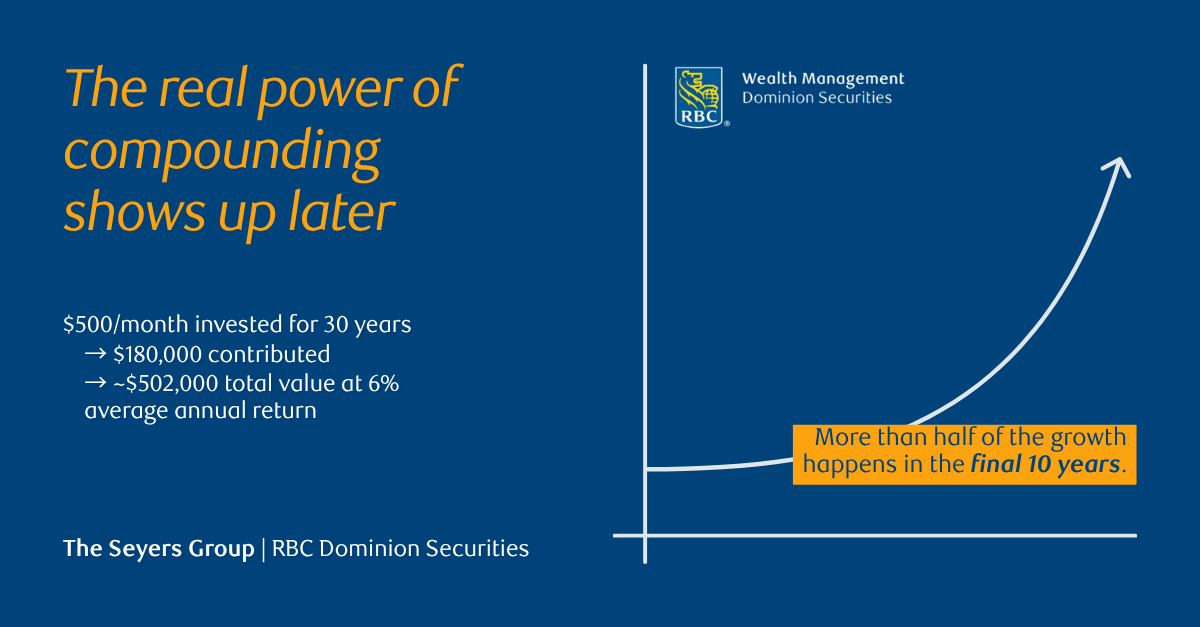
Investing $500 a month for 30 years would mean $180,000 of your own contributions. Assuming an average annual return of 6%, that could grow to approximately $502,000.
What's particularly interesting is how much of that growth happens later in the journey. The longer your money has to compound, the more powerful the effect becomes.
That's one of the reasons we encourage clients to start when they can and, perhaps even more importantly, to stay consistent.
Dividends: Where Compounding Does Its Best Work
For us, dividends have always been an important part of the conversation around creating long-term income.
When dividends are reinvested, they can purchase additional shares. Those additional shares can then generate dividends of their own. Over many years, that cycle can become a powerful part of compounding.
Here's a simple hypothetical example:
If you invested $100,000 at a 4% dividend yield, you'd receive $4,000 of income in the first year.
If that dividend income grew by an average of 7% per year, your annual income could grow to approximately $21,700 after 25 years without adding another dollar of your own money.
Of course, real-world investments don't grow in a perfectly straight line. Companies can change their dividends, markets move up and down, and circumstances change.
That's why we don't simply look at the dividend a company is paying today.
We want to understand the business behind it. Is it generating sustainable earnings? Does it have a history of growing its dividend? Is the business positioned to continue creating value over the long term?
For our clients, it's about looking beyond today's numbers and understanding what we're actually investing in.
From Building Wealth to Living on It
For much of your working life, the focus is on building your wealth. Eventually, though, the question changes to:
How are we going to turn what we've built into income we can live on?
That's where the years of planning and compounding start to become especially meaningful.
For someone with a dividend-focused portfolio, one of the benefits is the ability to receive income from their investments without necessarily having to sell shares every time money is needed. When the time comes to start drawing from your portfolio to cover living expenses, the shift can be remarkably simple: stop reinvesting the dividends and start collecting them. The same investments that helped build your wealth can now help fund the lifestyle you’ve worked hard to create.
It provides another layer of flexibility when it comes to managing retirement income, spending, and taxes. And when markets go through a difficult period, having income coming from the underlying investments can give you another option rather than automatically having to sell investments to fund your lifestyle.
The goal isn't simply to have a large portfolio. The goal is to have a portfolio that can support the life you want to live.

When the Unexpected Happens
Perhaps the most meaningful part of Bob and Sue's story is what happened after Bob passed away. Sue was going through an incredibly difficult time. But she didn't also have to wonder:
Where are our accounts?
What income will I have?
Who do I call?
What happens next?
She knew where everything was. She understood where her income was coming from. And she knew there was a plan in place.
That kind of confidence doesn't happen by accident.
It's the result of having conversations early, planning together, and making sure the financial pieces are in place before they're needed.
With year-end approaching, it's a good time to revisit some of the basics:
- Beneficiary designations. RRSPs, RRIFs, and TFSAs allow you to name beneficiaries directly. In many circumstances, naming a spouse can provide important tax and estate-planning benefits. For TFSAs, naming a spouse as successor holder can allow the account to continue in the spouse's name.
- Wills and powers of attorney. Make sure your documents reflect your current wishes and family circumstances, and that your loved ones know where to find them.
- A plan for the surviving spouse. When one spouse passes away, household income can change. Some benefits may stop or change, pension income-splitting opportunities may change, and the surviving spouse may have a different tax situation. Understanding these changes ahead of time can help avoid surprises.
- Both spouses understanding the plan. It's common for one person in a household to take the lead on finances. But making sure both partners understand the accounts, the income, the plan, and who to call can make a tremendous difference when one spouse is suddenly responsible for everything.
Every family is different, which is why we work closely with our clients and, when appropriate, alongside their lawyers, accountants, and RBC's estate and tax specialists.

A Closing Note
What stays with us most about Bob and Sue's story isn't the size of their portfolio. It's how ordinary the decisions were.
They invested regularly. They owned good businesses. They stayed patient. They planned ahead. And they kept going.
None of those decisions were particularly dramatic on their own. But over several decades, they added up to something significant.
And when life changed, that planning became about much more than investments. It gave Sue confidence that she would be okay. It gave her a clear understanding of her income and her financial plan. And it created an opportunity to pass something meaningful on to the next generation.
That's really what we believe wealth planning is about.
Whether you're just starting to build your wealth, approaching retirement, or thinking about what you want to leave behind, we're here to help you make a plan and, just as importantly, help you stay with it.
As we've believed for nearly four decades:
Wealth is built over a lifetime. Legacy is what it becomes when it's planned with care.
Sincerely,
The Seyers Group
The Seyers Group is welcoming a few new clients, especially families and individuals approaching or in retirement. Know someone who'd be a good fit? Let's connect.
RBC Wealth Management is a business segment of Royal Bank of Canada. For further information on the entities that are member companies of RBC Wealth Management, click here. The content in this publication is provided for general information only and is not intended to provide any advice or endorse/recommend the content contained in the publication.
® / ™ Trademark(s) of Royal Bank of Canada. Used under licence. © Royal Bank of Canada 2026. All rights reserved.