
The Seyers Group
RBC Dominion Securities Inc.
September 1, 2026
A Tax Most Retirees Never See Coming
Every year, we meet retirees who did everything right; they saved diligently, built a solid nest egg, and arrived at retirement with a real plan. Yet some are still caught off guard by a letter or a slightly smaller OAS deposit. It's not because they made a mistake. It's because the OAS clawback is one of the least understood parts of retirement income planning, and it deserves a plainer explanation than it usually gets.
Unlike CPP, you never contribute to OAS during your working years; it's funded entirely out of general tax revenues, not a personal account you paid into. Its intent is to provide universal pension income to Canadians aged 65+ who meet residency and citizenship requirements, regardless of work history. That's part of what makes the clawback feel unfamiliar: it isn't a benefit you funded being taken away, it's a universal one being scaled back based on how much other income you have.
Officially called the OAS pension recovery tax, the clawback works like this: once your net income for a year rises above a government-set threshold, the CRA reduces your OAS pension by 15 cents for every dollar above that line. It isn't a separate bill; it's simply a smaller deposit, spread across the following year's monthly payments.
For example: a retiree with $100,000 in net income, against a $93,454 threshold, is $6,546 over the line. At 15%, that's $981.90 clawed back over the year, or roughly $82 less in OAS each month. It's not dramatic on its own, but it adds up as income climbs further above the threshold.
The threshold moves every year. For 2025 income (determining payments from July 2026 through June 2027), it's $93,454, with OAS fully eliminated once income passes roughly $152,062 ($157,923 for those 75+). Looking ahead, the threshold based on 2026 income, shaping payments from July 2027 through June 2028, rises to $95,323, worth keeping in mind for income decisions made this year.

It Is Not Just How Much You Make. It Is Where It Comes From
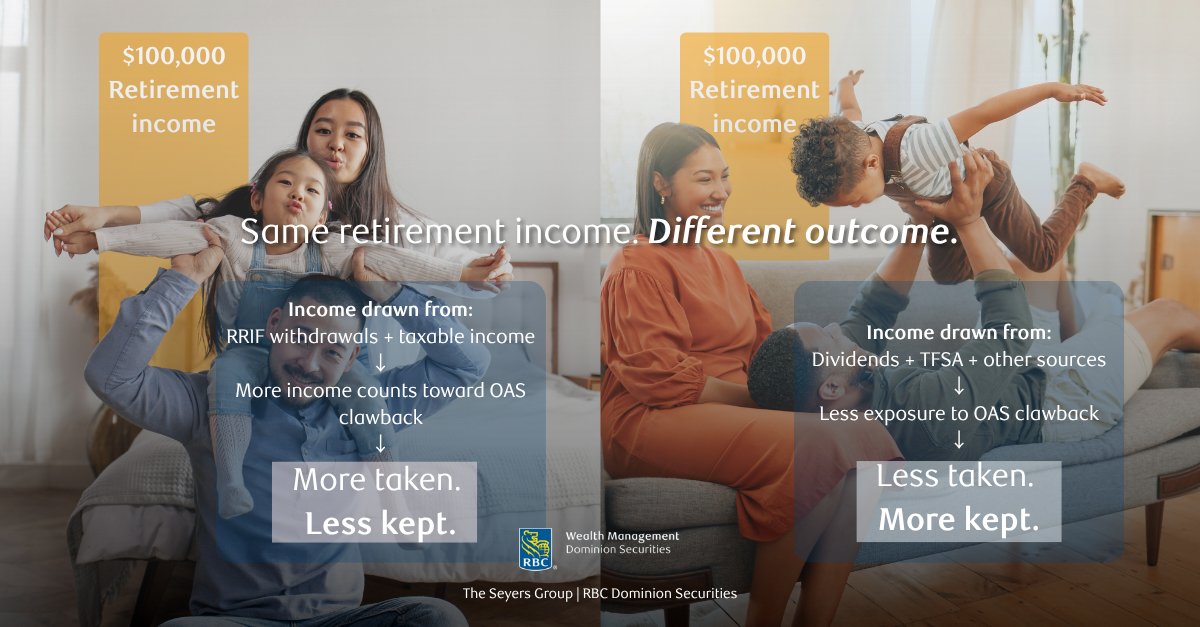
Two retirees with identical total income can face very different clawback outcomes purely based on where that income comes from. Not every dollar counts the same way: RRIF withdrawals, employment income, interest, and the taxable half of a capital gain all count toward net income. TFSA withdrawals don't count at all, regardless of amount. Canadian dividend income does count, but comes with the dividend tax credit, which offsets a meaningful portion of the tax owed, making it more efficient than income from other sources.
Consider two retirees, each with $100,000 of net income. One draws it entirely from a RRIF. The other draws part from Canadian dividend-paying investments and supplements the rest with TFSA withdrawals. Both may look identical on a bank statement, but their clawback exposure and actual after-tax income can differ meaningfully.
This is a large part of why we've built portfolios around individually selected, dividend-paying companies for our clients over the years. Predictable income from businesses with a real track record of paying and growing dividends gives retirees more room to plan around a threshold like this than income that arrives unevenly, the way a large RRIF withdrawal or one-time capital gain often does.
What You Can Actually Do About It
There's no single fix. But we regularly walk clients through several strategies, and the earlier they're discussed, the more options are on the table:
- Pension income splitting. If you have a lower-income spouse, splitting eligible pension income between you can bring your individual net income under the threshold, even with unchanged household income.
- Timing RRSP and RRIF withdrawals. Drawing down registered accounts earlier, sometimes before 65, can reduce the size of mandatory RRIF withdrawals later, which otherwise stack on top of OAS and CPP in your highest-income years.
- Leaning on your TFSA in the right years. Since TFSA withdrawals aren't counted as income, a well-funded TFSA is a lever to pull in years your other income runs close to the threshold.
- Deferring OAS itself. Delaying OAS past 65, up to age 70, permanently increases your monthly payment and can make sense if you expect higher income and clawback exposure in your late sixties than later.
- Spreading out capital gains. Since only half a capital gain is taxable, selling gradually across more than one tax year can keep you further from the threshold than realizing the full gain at once.
None of these strategies work well in isolation. The right combination depends on your income sources, timeline, and goals, which is exactly the conversation worth having well before year-end, not scrambling to have in April.

A Closing Note
If any of this sounds familiar, you're not alone. The OAS clawback is a quiet mechanic buried in the tax system, not something most people are taught to watch for, and it has a way of catching even the most careful savers off guard.
There are genuine, strategic ways to be intentional about how you decumulate your assets so more of your OAS stays in your pocket. But it's worth saying plainly: if your income ultimately puts you above the threshold and you receive reduced OAS, or none at all, that isn't a shortfall. More often, it's a reflection of the retirement income you've built over a lifetime, and something to be proud of.
September has a way of putting people back in a planning mindset. If you're approaching 65, already receiving OAS, or simply unsure how your income sources stack up against these thresholds, we'd genuinely welcome the conversation. That's what we're here for.
As we've believed for nearly four decades, retirement planning was never just about how much you saved. It's about how much of it you actually get to keep.
Sincerely,
The Seyers Group
"How will you replace your current income in retirement?™"
The Seyers Group is welcoming a few new clients, especially families and individuals approaching or in retirement. Know someone who'd be a good fit? Let's connect.
RBC Wealth Management is a business segment of Royal Bank of Canada. For further information on the entities that are member companies of RBC Wealth Management, click here. The content in this publication is provided for general information only and is not intended to provide any advice or endorse/recommend the content contained in the publication.
® / ™ Trademark(s) of Royal Bank of Canada. Used under licence. © Royal Bank of Canada 2026. All rights reserved.