
Thiessen Shackleton Wealth Management
January 7, 2026
Investing is, at its core, an exercise in storytelling. To be a successful investor in a growth-dominated era, one must look beyond the raw data and recognize the underlying "treasure map" that connects technological shifts to economic reality. Today, that story has evolved from a simple software narrative into a complex Architectural Supercycle.
As we enter 2026, we are employing a Barbell Strategy to navigate this landscape. On one end, we are anchored by "Heavy Artillery"—the global financial and industrial giants making new all-time highs. On the other hand, we are aggressive in the "Physical Layer"—the energy and optics infrastructure required to power the next generation of AI inference. This is not just about staying invested; it is about recognizing that the "game has changed" and positioning ourselves where the music is just starting to play.
While many observers look for signs of a late-cycle peak, the "weight of the evidence" suggests that the current bull market remains robust, supported by broadening participation and an AI-driven "supercycle" that is fundamentally reshaping corporate earnings.
We anticipate a year defined by sequenced volatility: initial momentum fueled by fiscal stimulus and technological acceleration, followed by a seasonal "midterm" consolidation, before a year-end rally.
"Smothering Heights": Concentration and the $18 Trillion Moat
J.P. Morgan’s 2026 Outlook, aptly titled "Smothering Heights," highlights an unprecedented concentration in the global markets. Since the launch of ChatGPT in 2022, a narrow group of 42 AI-related companies has generated nearly 75% of S&P 500 returns and earnings growth.
●The Moat: The market capitalization of just four hyperscalers and their semiconductor partners has surged from $3 trillion to $18 trillion in a few short years.
●The Risk: This "generative AI theme" has effectively smothered the rest of the equity market. Without these 42 stocks, the S&P 500 would have underperformed international markets, such as those in Europe and Japan, over the last three years.
●Capital Intensity: These firms have committed $1.3 trillion to capital expenditures (capex) and research and development (R&D) since 2022. The question for 2026 is: when does this massive investment translate into sustained, diversified profits for the broader economy?
The Weight of Evidence: A Market of All-Time Highs
Unlike the fragile, narrow leadership that preceded the 2000 and 2008 collapses, today's market is characterized by extraordinary breadth.
●NYSE Composite (NYA): Represents the full universe of global bellwethers; its recent breakout to new highs indicates that this is not just a U.S. "tech bubble" story but a global cyclical expansion.
●Russell 3000: Covering 98% of the investable U.S. market, this index is also at record levels, proving that the trend is "up and to the right" across nearly every sector.
●Dow Theory Confirmation: Both the Dow Jones Industrial and Transportation Averages are trending higher together—a classic signal that goods are being produced and moved efficiently throughout the economy.
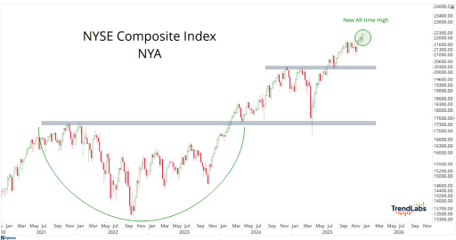
Chart courtesy of Trend Labs
The "Treasure Map": Small-Cap Financials
The most compelling "wow" factor in the 2026 landscape is the S&P 600 Small-Cap Financials (PSCF).
●A Decade-Long Base: Regional banks have spent years grinding sideways, forming one of the cleanest and longest bases in global markets.
●The Bullish Signal: We believe that if the most "vulnerable" part of the market—regional banks—breaks out to fresh highs, the debate over an imminent credit crisis is over.
●Participation: We don't get true bull markets without financials; large-cap banks are already leading, and the "little guys" joining the party would be the heavy artillery the market needs for its next leg higher.
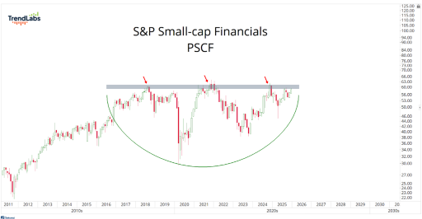
Chart courtesy of Trend Labs
The AI Supercycle: From Training to Inference
The AI Tech Value Stack has entered a phase of exponential complexity.
●Hyper-Scale Capex: Big tech companies have tripled their annual capital investment toward a projected $500 billion in 2026.
●The Advertising Advantage: Research shows that Generative AI-created ads from scratch can boost click-through rates (CTR) by 19%. This supports the long-term bull case for platforms like Meta and Google.
●The "Bitter Lesson": Systems that scale with compute and data consistently outperform hand-engineered structures.
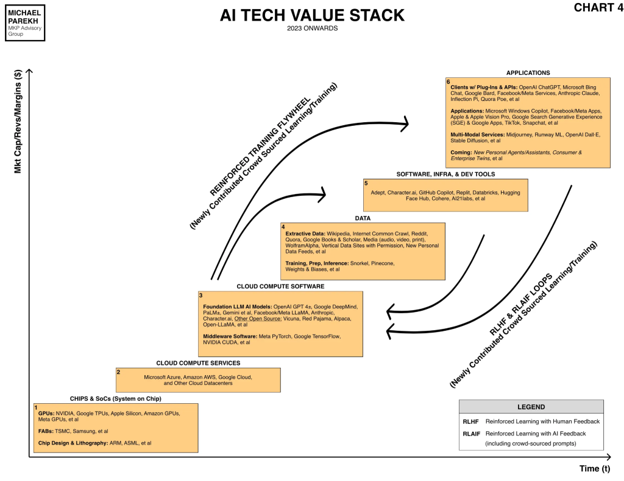
The Energy Bottleneck: "Bring Your Own Generation" (BYOG)
The primary constraint on the AI supercycle has shifted from silicon to power. In states like Texas, the electric grid is essentially "sold out," with load requests vastly exceeding approved capacity.
●Onsite Revolution: To bypass the 5-year interconnection queue, AI labs are pivoting to Bring Your Own Generation (BYOG).
●The xAI Playbook: Elon Musk’s Colossus facility proved that mobile gas turbines can bring a gigawatt-scale data center online in months rather than years.
●Market Opportunity: This is driving triple-digit growth for onsite gas generation. Key beneficiaries include GE Vernova and Siemens Energy, as well as new entrants like Wärtsilä and Doosan Enerbility.
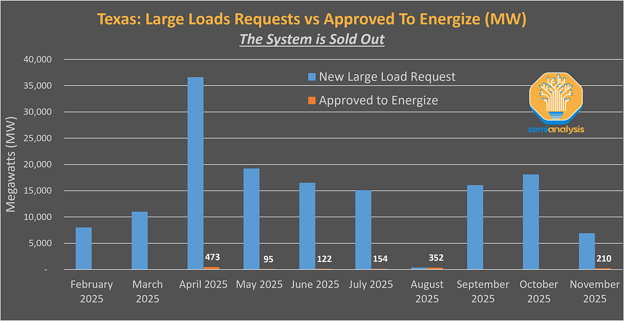
Chart Source: Semi Analysis

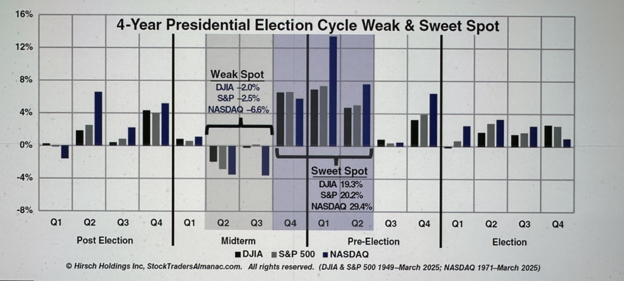
Seasonality: Navigating the Midterm Year
2026 is Year 2 of the four-year Presidential Cycle, historically the most challenging stretch for markets.
●The "Weak Spot": We expect relative weakness in Q2 and Q3, with the S&P 500 potentially experiencing 4–14% "choppy" drawdowns.
●The October "Sweet Spot": This seasonal low historically marks the beginning of a powerful run that carries markets deep into the pre-election year (2027).
●Strategy: We respect the trend but stay sharp. If no "culprit" sector emerges to drag the market down, we treat drawdowns as opportunities to add to high-conviction positions.
Source: Stock Traders Almanac
The Optics Frontier: The Backbone of the AI Supercycle
While chips dominated the 2024–2025 narrative, 2026 is the year of Optics and Interconnects. The physical reality of AI is that networking has become the primary bottleneck for performance.
The "Scale-Out" Imperative
AI data centers require a fundamentally different architecture than traditional cloud facilities. Unlike standard "North-South" traffic (client-to-server), AI clusters are defined by heavy "East-West" traffic (server-to-server), where thousands of GPUs must communicate simultaneously to process massive datasets.
●36x Fiber Density: AI-focused data centers require approximately 36 times more fiber than traditional CPU-based racks to handle these massive data volumes.
●Ultra-Low Latency: To maintain the "reinforcement loops" necessary for AI training, signal loss and latency must be near zero. This is driving the adoption of Hollow-Core Fiber (HCF), which allows light to travel through air instead of glass, reducing transmission latency by up to 30%.
Strategic Positioning in the Supply Chain
The global fiber market is projected to grow from $9.26 billion in 2025 to over $15 billion by 2033.
●Inventory Scarcity: Demand is currently so high that at least one major global manufacturer has already sold all fiber inventory through 2026.
●Optical Equipment Leaders: Companies like Ciena (CIEN) have raised revenue guidance significantly for 2026, positioning high-speed fiber solutions as the critical path for moving data between compute nodes.
●Next-Gen Standards: We are seeing an accelerated shift toward 800G and 1.6T high-speed optical components, which are required for the newest generation of GPU clusters.
Emerging Markets: The Global AI "Picks and Shovels"
Emerging Markets (EM) in 2026 are no longer a monolithic asset class; they are a fragmented landscape of structural growth stories and AI enablers.
The "AI Corridor": Taiwan and South Korea
These markets remain the indispensable foundation of the global technology stack.
●Fabrication and Assembly: 100% of specialized AI processors (GPUs/TPUs) are currently fabricated by TSMC in Taiwan, and the servers are primarily assembled by Asian giants like Foxconn.
●Memory Dominance: The "High-Bandwidth Memory" (HBM) required for AI is almost entirely controlled by Korean manufacturers like Samsung and Hynix, which supply 90–100% of the memory for the latest Nvidia and Google chips.
China’s Industrial and Tech Pivot
Despite property sector headwinds, China is emerging as a leader in applied AI and renewables.
●Innovate First, Regulate Later: China’s regulatory approach gives it a clear lead in autonomous vehicles, robotics, and biotech.
●Global Battery Hub: Companies like CATL control roughly 40% of the global battery market, a critical component as data centers look for energy storage solutions to bypass the grid.
The India Growth Premium
India remains one of the fastest-growing structural stories, driven by domestic consumption and governance reforms. While active trade talks with the U.S. continue, India’s lower reliance on exports makes it more resilient to direct tariff shocks than its regional peers.
Commodities: A Market of Structural Divergence
The 2026 commodity landscape is defined by a "Selective Regime" where electrification and monetary credibility drive performance, while traditional energy faces a surplus.
Electrification Metals
The "BYOG" (Bring Your Own Generation) trend in data centers and the global energy transition are creating a long-term supply deficit in industrial metals.
●Copper & Aluminum: Essential for electrical wiring in AI facilities and EVs, copper faces a $12,000–$14,000 per ton bull case in 2026. Aluminum is uniquely leveraged to AI/data center growth and has very limited new supply coming online.
●Uranium: We are increasingly bullish on uranium. RBC, JPM, and Morgan Stanley are forecasting $100 per pound by late 2026 as nuclear power sees a resurgence to meet the data center industry's massive baseload energy needs.
Monetary Hedges: Gold and Silver
Gold enters 2026 with historic structural support from central banks diversifying away from the dollar.
●Structural Demand: Central bank gold purchases have accelerated as countries like China and India seek sanction-resistant assets and long-term diversification.
●Price Targets: Major banks are forecasting gold between $4,500 and $5,000 if macro conditions of high government spending and policy uncertainty persist.
The Bearish Divergence: Crude Oil
In contrast to the metals, the oil market faces a supply-driven downtrend along with continued geopolitical risk.
●Surplus Management: Non-OPEC supply is growing three times faster than demand, pushing the market into a surplus.
●WTI Forecast: We expect WTI prices to remain range-bound to lower, potentially averaging $59 per barrel in 2026 as the rapid electrification of transport begins to soften long-term demand growth.
Conclusion: The Patience of the Architect
We began this outlook by talking about the importance of storytelling, and there is no story more seductive than the one that promises a straight line to the top. But the history of great booms—from the railroads to the fiber-optic buildout of the 1990s—teaches us that the "straight line" is a myth. Real progress is messy, expensive, and often happens beneath the surface before it ever shows up on a ticker tape.
The Barbell Strategy we are employing today is our way of acknowledging that we don’t have a crystal ball, but we do have a compass. By anchoring one end of our barbell in the "Heavy Artillery" of global financials and the other in the "Physical Layer" of AI architecture, we are admitting that while we don't know exactly which software app will win the decade, we know with absolute certainty that they will all need power, they will all need light, and they will all need a functioning financial system to exist.
In the 1920s, everyone wanted to own the car companies; the wiser move was often owning the companies that made the asphalt. In 2026, we are buying the "asphalt" of the digital age—the optics, the modular power plants, and the regional banks that keep the gears of commerce turning while the headlines focus on the "Smothering Heights" of the mega-caps.
The most important lesson in investing is that the market doesn’t owe us a smooth ride. We expect the "midterm" jitters; we expect the Q2 "choppy grind". But we also know that the weight of the evidence - the record highs, the broadening participation, and the insatiable demand for a new kind of infrastructure - points to a trend that is still very much "up and to the right".
We are not just witnesses to this architectural shift; we are participants in it. Our job is not to predict the exact date the music stops, but to make sure we are dancing in the right room until it does.
Stay sharp and remember, in a world plagued by short attention spans, the greatest advantage we have is our longer time horizon.
RBC Dominion Securities Inc.* and Royal Bank of Canada are separate corporate entities which are affiliated. *Member-Canadian Investor Protection Fund. RBC Dominion Securities Inc. is a member company of RBC Wealth Management, a business segment of Royal Bank of Canada. â / ™ Trademark(s) of Royal Bank of Canada.Used under licence. © RBC Dominion Securities Inc. 2026. All rights reserved.
This information is not investment advice and should be used only in conjunction with a discussion with your RBC Dominion Securities Inc. Investment Advisor. This will ensure that your own circumstances have been considered properly and that any action is taken based upon the latest available information. The strategies and advice in this report are provided for general guidance.Readers should consult their own Investment Advisor when planning to implement a strategy. Interest rates, market conditions, special offers, tax rulings, and other investment factors are subject to change. The information contained herein has been obtained from sources believed to be reliable at the time obtained but neither RBC Dominion Securities Inc. nor its employees, agents, or information suppliers can guarantee its accuracy or completeness.This report is not and under no circumstances is to be construed as an offer to sell or the solicitation of an offer to buy any securities. This report is furnished on the basis and understanding that neither RBC Dominion Securities Inc. nor its employees, agents, or information suppliers is to be under any responsibility or liability whatsoever in respect thereof. The inventories of RBC Dominion Securities Inc. may from time to time include securities mentioned herein.