Thiessen Shackleton Wealth Management
July 8, 2026
Access our PDF Quarterly Newsletter here: TSWM Quarterly Letter - Q3 2026.pdf
Dear Clients and Friends,
The Harvard economists Carliss Baldwin and Kim Clark once argued that the most important economic event in a technology industry is usually not the invention of a new product. It is the moment the industry settles on a modular architecture with stable useable interfaces.
Think I0S on your iPhone.
The personal computer is the classic case. Once the interfaces were fixed, Intel could improve processors (CPUs), Microsoft could improve operating systems (Microsoft 365), and thousands of independent vendors could innovate without asking anyone's permission. The ecosystem improved along every axis at once. A few vertically integrated companies prospered. But "a computer in every home and on every desk" became possible through disaggregation.
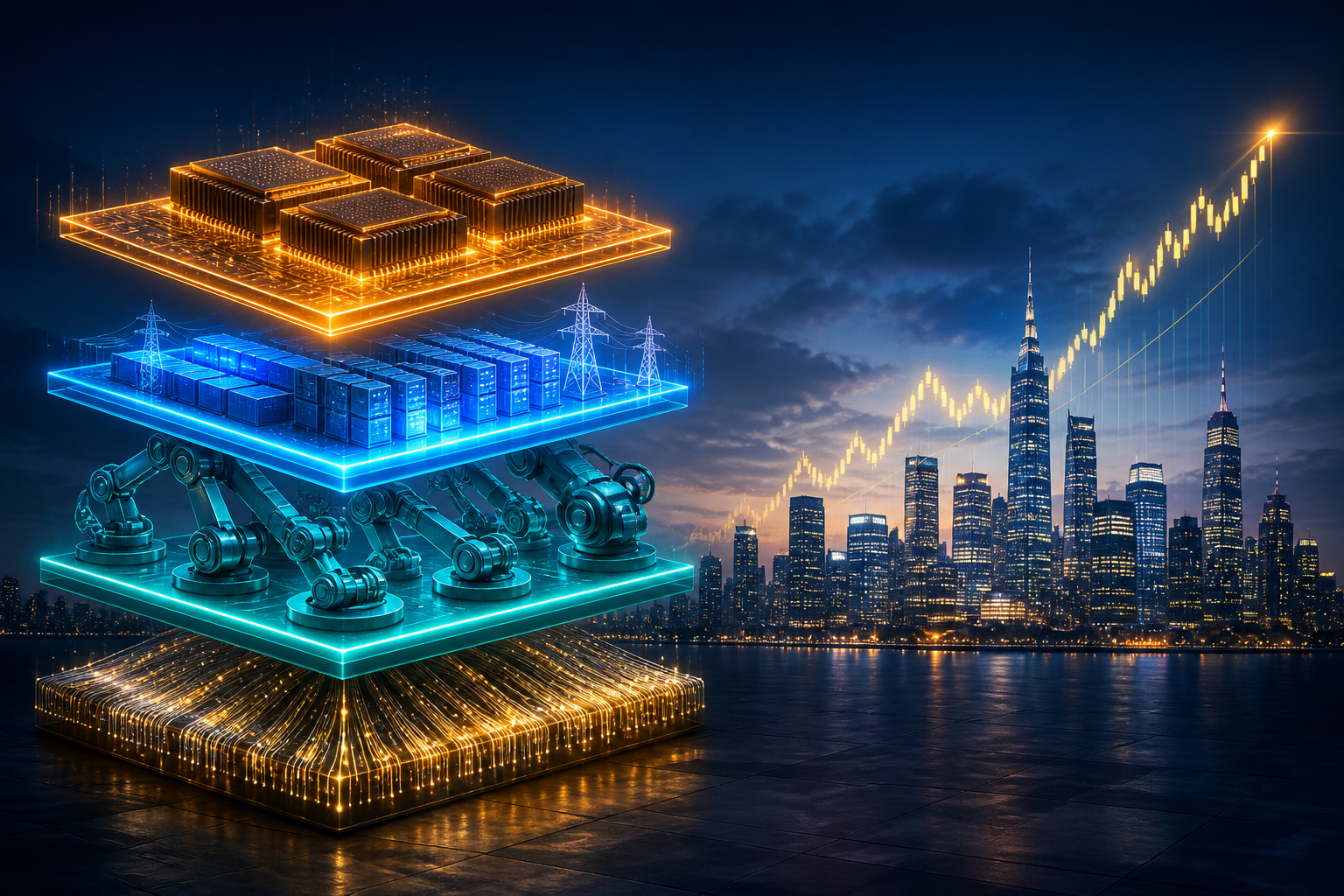
We open a client letter with a forty-year-old story about personal computers because we believe the same event has just happened in artificial intelligence. AI has quietly converged on three standardized interfaces:
- the transformer architecture below,
- the inference API in the middle, and
- the "agentic harness" which is the software loop that turns a model's stream of tokens into actual work above
The results are hard to overstate. One inference provider watched the tokens flowing through its APIs grow nearly 10,000-fold in nine months, from 30 billion a month to 400 trillion. Autonomous agents capable of long-running tasks with little supervision have moved from demos into production. Tokens are becoming a fundamental resource, like electricity or bandwidth, and the stack that produces them is unbundling into specialized layers, each with its own markets, suppliers, and winners.
Why does this matter to your portfolio?
Because when a technology stack modularizes, value stops pooling in a single vertical winner and starts forming at every layer - and an advance anywhere diffuses across the whole ecosystem. That is the single most important thing happening in markets today. It is why the AI trade is broadening far beyond a handful of chip stocks, and it is the thread that runs through everything in this letter:
Memory, power, robot parts, software, and even a Canadian pipeline.
But first, the quarter's shocks.
The Moment: A War, a Deal, and a New Fed Chair
The first half handed markets three genuine shocks and how they resolve will shape the next four quarters.
The Iran war that began in late February closed most of the Strait of Hormuz, produced an unprecedented energy shock, and pushed U.S. headline CPI to 4.2% in May, a three-year high. Then, in mid-June, negotiators reached a 60-day memorandum of understanding: Iran reopens the strait, the U.S. lifts its blockade of Iranian ports, and both sides buy time to negotiate the harder nuclear questions. Brent fell from the mid-$80s to the high-$70s within days. If oil flows keep normalizing, May was very likely the inflation peak. Falling gasoline prices alone could take a meaningful bite out of the June CPI print, and tariff relief, cooling rents, and moderate wage growth all point the same direction into 2027.
The second shock was institutional. Kevin Warsh was confirmed as Federal Reserve chair in May and chaired his first FOMC meeting on June 17, holding the funds rate at 3.50–3.75% in a unanimous vote. Markets have swung from pricing three cuts this year to pricing a possible hike, and nine of nineteen Fed policymakers now pencil in higher rates. Our read: the Fed stays on hold. Warsh will not hike into an inflation spike that is mostly oil, and he will not ease with CPI wearing a four-handle. Rates stay higher for longer, which is not the disaster it sounds like — two-year Treasuries now pay roughly 60 basis points over cash, which means bond investors are finally being paid to wait.
The third is political. The U.S. midterms arrive in November, and polls suggest the House flips. If it does, further fiscal stimulus in 2027 becomes unlikely and the economy settles back toward trend growth. Between now and then, expect a stimulus push into the election and a jittery long end of the bond curve. We are keeping duration short.
Here is what should strike you about all three shocks: U.S. stocks made 24 new all-time highs through them. Not because investors are complacent. Because earnings did the work.
Are We Bullish? The Market Already Answered
A recent Allianz survey found 62% of Americans believe a major recession is right around the corner, and only one in four thinks now is a good time to invest. That fear is everywhere. The market is telling a different story, and we think the market has the better argument.
The S&P Banks Index ($KRE) just closed at a new all-time high, the first time it has traded above its January 2007 peak. Think about what sits inside those nineteen years: the financial crisis, Lehman, a pandemic, an inflation spike, and the fastest hiking cycle in decades. Markets spend far more time moving sideways than moving up, because investors who bought near an old peak sell every time prices get back there. When those sellers are finally exhausted, supply dries up, and the biggest moves begin. The longer the base, the more meaningful the breakout. Twenty years is a very long base.
Banks are not just another sector. They sit at the center of the economy: when they are healthy, lending expands, businesses invest, consumers spend. If a recession were truly imminent, historic strength in banks is the last thing you would expect to see. Instead, banks joined industrials and small caps at record highs, the NYSE advance-decline line hit a new all-time high, and over 75% of cyclical subindustries are in bullish trends on both short and long-term measures. Going back to the 1960s, that combination has occurred less than 4% of the time, and it has historically been followed by double-digit annualized returns.
The earnings picture is just as emphatic.
First-quarter S&P 500 earnings grew 27% year over year, with a further 20% expected for Q2. The index is reporting a 13.4% net profit margin which is the highest since records began in 2009, with analysts expecting margins above 14% through the back half. Technology sector margins hit 29%, up four points in a year. And here is the part most commentators miss despite near double-digit returns this year, valuation multiples have compressed roughly 7%, because earnings expectations rose faster than prices. After-tax corporate profits now run 14% of GDP, double the 1990s average.
So yes, we are bullish. Profitability is at record levels and still improving, the most economically sensitive parts of the market are breaking out, and the market got cheaper relative to its earnings power while making new highs.
Our one caveat: volatility is building under the surface, and we expect the next leg higher to be a rougher ride than the last one.
The Main Story: Intelligence Is Being Industrialized
Return to the Baldwin and Clark story. First consequence of a modular stack is that building a frontier AI model has become dramatically cheaper and faster. The architecture is shared, the training machinery is shared, and every advance diffuses sideways within weeks of being published. The frontier, until recently the property of a few labs, is being reached by many at once. Open-weight models now deliver tokens at an order of magnitude below closed frontier prices; in one recent test of identical agentic tasks, an open model was five times faster and 63 times cheaper than the leading closed one. When something gets cheaper that fast, rational companies stop buying the most capable version for every task, the same way no business hires a PhD mathematician to reconcile the books.
The defining metric of this industry is shifting from intelligence to intelligence per dollar.
The second consequence: when models become interchangeable parts, the moat migrates to whoever coordinates them. Enterprises are learning to route cheap models for routine work, frontier models for the problems where extra intelligence genuinely pays and the routing decision is where the customer relationship now lives. Amazon's Bedrock, Microsoft's Azure AI Foundry, and Google's Vertex are converging on the same position: the operating system of enterprise AI, holding the company's context, memory, security, and compliance while the model underneath becomes swappable.
A useful analogy: the frontier labs are airlines, competing brutally on service while yesterday's premium becomes today's standard. The hyperscalers are airports. Every flight still lands on their runway, whoever wins the route. Sun Microsystems was "the dot in dot-com" until Linux and commodity chips crossed "good enough", and the premium for the vertical winner collapsed, but the ecosystem got vastly larger. We want to be positioned for this future ecosystem.
Does cheaper intelligence mean less compute?
History says the opposite. When storage got cheap, we stored vastly more. When bandwidth got cheap, text became streaming video. Cheap inference means agents that run continuously instead of occasionally, software that calls models by default, and thousands of use cases that were uneconomic at last year's prices. Every token still consumes someone's GPU, in someone's data center, on someone's power contract. The world runs 15–20 gigawatts of AI capacity today; credible forecasts put it at 150 gigawatts within five years, implying $6–7 trillion of infrastructure investment.
Hyperscalers will spend roughly $700 billion this year alone, and Meta contracted over five gigawatts of capacity in the first six months of 2026. The market keeps treating this spending as an expense. We feel this is much more likely to be one of the largest productive asset bases ever assembled.
The portfolio consequence is the one we care most about: the AI trade has stopped being one stock.
NVIDIA's suppliers have outperformed NVIDIA's customers by 186 percentage points this year. Within semiconductors, the winners have broadened from AI chips to memory and CPUs. Power and electrical equipment earnings are growing 30–40%. Emerging markets are up ~23% this year largely because Korea and Taiwan sit at the center of the AI hardware supply chain.
And the jobs data supports the optimists: companies investing most heavily in AI grew white-collar headcount 10.2% in the two years after adoption, with entry-level employment up 12%. The opportunity is no longer confined to semiconductors. It is forming at every layer of the stack, and the next three sections are where we are hunting.
Memory Is the Bottleneck and the Next Leg Higher
Every AI accelerator on earth, whatever the logo on the box, depends on high-bandwidth memory. HBM is effectively sold out through 2026, with 2027 allocations already being negotiated. The constraint is structural: producing one bit of HBM consumes roughly three times the wafer capacity of conventional DRAM, and the advanced packaging needed to stack it is just as scarce. Samsung and SK Hynix are both warning that shortages persist through 2027 and beyond even as they pour hundreds of billions into new capacity. This is why memory earnings are, in the words of one strategist, skyrocketing, and it is why we own the memory complex — SK Hynix, Micron, and Samsung Electronics — as a core expression of the AI theme.
The next leg, and the less crowded one, is NAND flash. As AI shifts from training models to running them at scale, the binding constraint moves toward storage: model weights, context, and memory all need sustained, low-latency access that mechanical drives cannot deliver. Supply is tightening at exactly the wrong moment for buyers — manufacturers have been converting NAND lines to DRAM to chase HBM margins, and Kioxia says its entire 2026 NAND output is already sold out, with its next-generation 332-layer flash pulled forward a full year and consortium capital spending up 41%.
The structural answer to the memory bottleneck is called high-bandwidth flash — NAND engineered to sit next to the GPU and do part of HBM's job at a fraction of the cost, expanding effective memory capacity for inference. SanDisk and SK Hynix expect first samples in late 2026 and the first AI-inference devices in early 2027. If it works, storage stops being a commodity that cycles with smartphone demand and becomes part of the compute stack itself. That is a re-rating, not a cycle, and we want to own it before the market fully agrees.
How to Invest in Robots: Buy the Parts
Physical AI is coming faster than most investors appreciate, and Asia currently leads its deployment. But here is our honest position: we do not know which humanoid robot platform wins, and neither does anyone else. Fortunately, and this is the modularity lesson again, we do not need to know.
Actuators are the motorized joints that make a robot move, and these represent 40–60% of a humanoid's bill of materials.
Tesla's Optimus carries 28 joint actuators in its body and more than 50 more in its hands alone, and the precision gearbox inside each one is 30–50% of its cost. Add the sensors, rare-earth magnets, batteries, and precision components, and a clear picture emerges: the bottlenecks for the entire industry sit in the supplier base, not the brands.
Platform prices will fall 15–20% with every doubling of volume which is brutal for the robot makers, wonderful for the parts makers who ship components to all of them. It is the same playbook that made semiconductor equipment the best way to own the chip boom: when you cannot pick the winner, own the toll road every contender must drive down.
Software Is Not Dead… But It Is Being Re-Priced
Software has been the whipping boy of 2026. It's the markets Darnell Nurse.
The sector sold off hard as investors began pricing the "disrupted" alongside the "disruptors," worried that AI agents will do what seat-based software used to charge for. This fear is not baseless because models that once scored 2% on the standard software-engineering benchmark now sit above 85%, and writing code is becoming industrial rather than artisanal.
But notice what drove the selling: uncertainty about future business models, not any deterioration in current fundamentals. That is exactly the kind of indiscriminate repricing that creates opportunity, because not all software is created equal…
Three kinds of software are very much alive.
First, software that owns context. As Palo Alto Networks' Nikesh Arora puts it, the lasting moat in AI is not the model but the memory a system builds about you. This is the accumulated context that makes every answer better and every switch more painful. Software that owns its customers' data, workflows, and history gets stronger in an agentic world, not weaker.
Second, security. CrowdStrike and Palo Alto both just closed their best quarters ever, because autonomous agents expand the attack surface, and the same models that write good code are frighteningly good at finding bad code, one model found in six weeks what a red team would have needed years to uncover. Every enterprise now must fix its systems faster, forever.
Third, software with opinions - products that read your work, tell you what is wrong, and act, rather than waiting for instructions. The dead zone is the thin workflow tool whose entire product is a user interface on a database. We want to own the first three categories and avoid the fourth.
At Home: Alberta's Pipeline and Canada's Moment
The most important Canadian financial story of the year is not on a stock exchange.
In May, Ottawa and Alberta signed the Implementation Agreement that turns last November's memorandum of understanding into a schedule: Alberta submitted its west coast pipeline proposal to the Major Projects Office on July 1; the federal government is expected to declare it in the national interest by October 1; construction approval is targeted for September 2027. The line would move one million barrels per day along the existing Trans Mountain corridor, with Canada and Alberta as equal partners, a meaningful Indigenous equity stake, and Pembina as private-sector investor. It is paired with the Pathways carbon capture project, and Ottawa says the combined agenda catalyzes roughly $200 billion of new investment across 23 nation-building projects.
Our team is not naive about the obstacles - producers are balking at their share of Pathways' cost, British Columbia remains opposed, and consultation risk is real. But egress has been the discount on Canadian energy for a decade, and this is the first credible fix since TMX. For our portfolios it reinforces positions we already hold: Canadian energy producers, pipelines and midstream, the engineering and construction complex, and the banks that will finance all of it.
Step back and the bigger picture is better still. In a world where energy security has become a sovereignty question, where nations are treating compute and energy alike as strategic inputs they must control; Canada is one of the few suppliers the world's democracies trust. Owning Canadian energy is one of our favourite ways to own the geopolitical regime itself.
Mitigating the Downside
Being bullish does not mean being blind.
Three things worry us.
- Concentration: the top ten companies are 41% of the S&P 500, and the U.S. is 64% of global equities and the biggest risk to this market is a single bad headline from a tech conference, a model release, or a funding round.
- Expectations: after this run, disappointments can arrive not because fundamentals are bad but because expectations have become unbeatable.
- And the tape itself: credit spreads are starting to widen from very tight levels, and realized volatility is creeping up beneath a calm surface.
Here is what we are doing about it. We diversify the diversifiers - real assets, infrastructure, gold, and absolute-return strategies alongside bonds, because bonds alone cannot hedge inflation risk. We hold the short end of the curve for income and dry powder. We own international value, European defense and infrastructure, Japanese governance reform, which gives us earnings growth driven by themes that have nothing to do with AI. We rebalance systematically and harvest tax losses along the way, so concentration never quietly builds up in your accounts.
And we stay invested: a balanced portfolio has historically recovered from a 20% equity drawdown in roughly half the time stocks alone required, and cash has underperformed a diversified portfolio yet again this year. The goal is not to maximize returns in any single regime. It is to make sure your plan survives every regime.
Closing Thoughts
The last time the bank index made a new all-time high, the iPhone did not exist. Nobody had heard of a token, a transformer, or a gigawatt-scale data center. The doubters at that moment were early by nine months; the doubters at this one, we suspect, are early by years, because the breakout in banks is the kind of evidence you get near the beginning of bull markets, not the end. Baldwin and Clark were right about the PC, and we believe they will be proven right about AI: the invention was never the whole story. The disaggregation is, and it is putting opportunity in every corner of this market.
Our job is to own that story deliberately while protecting you from its excesses.
Thank you for your continued trust. If anything in this letter raises questions about your own plan — call us. That conversation is the whole point.
With appreciation,
Thiessen Shackleton Wealth Management team
This information is not investment advice and should be used only in conjunction with a discussion with your RBC Dominion Securities Inc. Investment Advisor. This will ensure that your own circumstances have been considered properly and that any action is taken based upon the latest available information. The strategies and advice in this report are provided for general guidance. Readers should consult their own Investment Advisor when planning to implement a strategy. Interest rates, market conditions, special offers, tax rulings, and other investment factors are subject to change. The information contained herein has been obtained from sources believed to be reliable at the time obtained but neither RBC Dominion Securities Inc. nor its employees, agents, or information suppliers can guarantee its accuracy or completeness. This report is not and under no circumstances is to be construed as an offer to sell or the solicitation of an offer to buy any securities. This report is furnished on the basis and understanding that neither RBC Dominion Securities Inc. nor its employees, agents, or information suppliers is to be under any responsibility or liability whatsoever in respect thereof. The inventories of RBC Dominion Securities Inc. may from time to time include securities mentioned herein.