Thiessen Shackleton Wealth Management
September 30, 2026
The Bridges
Ben Thompson at Stratechery has a compelling way of describing how computing moves from one era to the next.
The mainframe did not lead to the personal computer because someone built a smaller mainframe. It led there because applications, programs you could interact with while they ran, created a reason for individuals to want a computer of their own. The PC did not lead to the smartphone because someone built a smaller PC. It led there because the internet, which ran on every PC and did not care which one, became worth carrying in your pocket. In each case the top layer of one era was the bridge to the next.
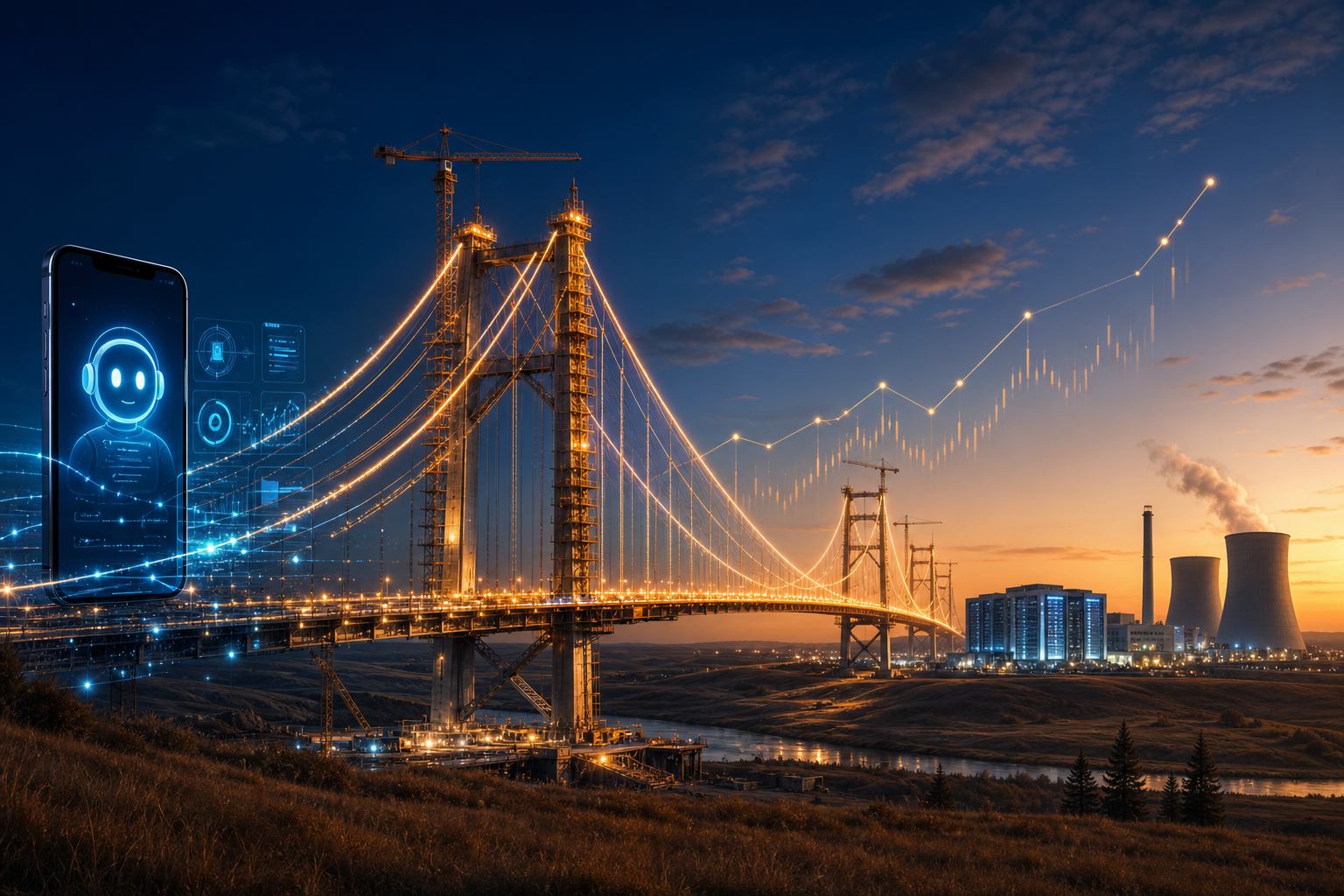
This argument, with regards to ai and LLMs, is looking better every week. In our opinion, generative AI is the bridge to whatever comes after the phone. This quarter that bridge stopped being a diagram. Meta gave every American a computer for their AI to use with Muse. Microsoft did the same for every office worker via Autopilot. The models that make it possible are now good enough that the labs building them are arguing in public about whether to slow down.
Interestingly, these proverbial bridges are also what markets do badly. They price the whole build before the concrete is poured and then panic when the concrete costs more than expected. The third quarter had both halves of that. The Federal Reserve raised rates for the first time since 2023 and the 10-year Treasury touched 5% for the first time since 2007, and the stocks whose value lives furthest in the future fell hardest. Then, with the release of Astra and Muse the market decided the future was a week away and bought it all back. Both reactions were to stories. The rest of this letter is about which stories we think are most important.
I. Macro: A Hawkish Fed, a Tired Tape, and an Election
The next month or so looks difficult, and we would rather say so than pretend otherwise.
So, let’s start with the Fed. On September 16 it raised its policy rate to a range of 3.75% to 4% on a 12 to 0 vote, and the committee's own projections raised its estimate of the neutral rate to the highest level since early 2016. Its members see more upside risk to growth than at any point in at least twenty years. Read that carefully. The Fed is not tightening because the economy is weak. It is tightening because the economy is too strong for an inflation rate that is still running 3.4%, and its own measure of financial conditions says they are adding to growth over the coming year rather than restraining it. As a result, markets are now pricing roughly a two-thirds chance of another hike in October. As RenMac put it, the former doves are turning hawkish. Oil coming off the boil in the last week has not stopped two-year yields from pressing to fresh highs, which tells you the bond market has moved on from the war and is now pricing the Fed.
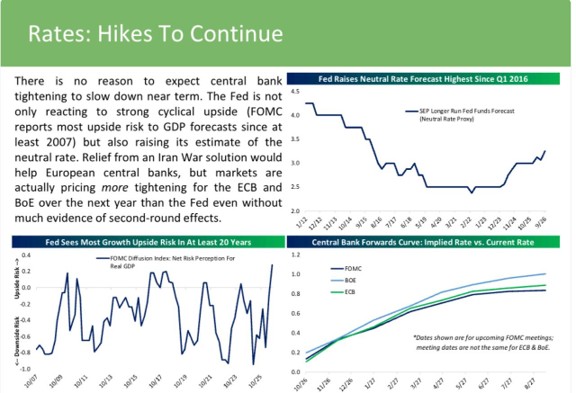
Source: Renaissance Macro Research, September 2026.
Then the tape. Beneath an index that is still up on the year, breadth has deteriorated sharply. Only about a quarter of S&P 500 companies are trading above their 50-day averages. In the Russell 1000 there were 39 stocks making relative-strength highs last week against 350 making lows. Spreads on the weakest tier of corporate credit are widening. The historical pattern after a first Fed hike, across six cycles back to 1994, is a median drawdown of about 6% in the following three months. None of this is a forecast of a bear market. It is a description of a market that is tired, has lost its leadership momentum, and has no obvious catalyst for the next four weeks.
We have positioned for that rather than against it.
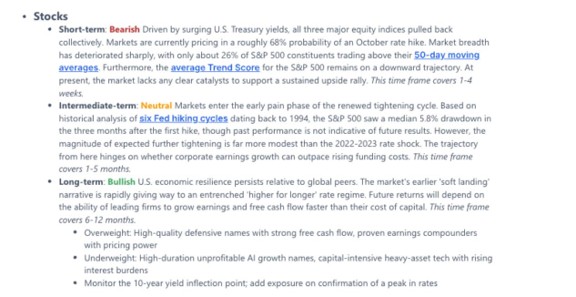
Source: Renaissance Macro Research, market outlook by time frame.
Which is why three parts of the portfolio matter more than usual right now.
Utilities have been sold as bond proxies all year, and the sector now trades at about 15.5 times forward earnings against 19.2 for the S&P 500, with earnings expected to grow 11% this year. That is a large discount for a group that is the primary supplier of the scarcest input in the AI buildout. It pays us to wait out the bond market. Energy did exactly what a hedge is supposed to do when the ceasefire broke in July and Brent went from $70 to $109, and its position in the portfolio stay at $100 because the bid for power is structural and has no seasons.
And gold, which we do not talk about often, is doing the job it does when real rates and inflation are both rising and the world's largest borrowers are competing with the Treasury for money.
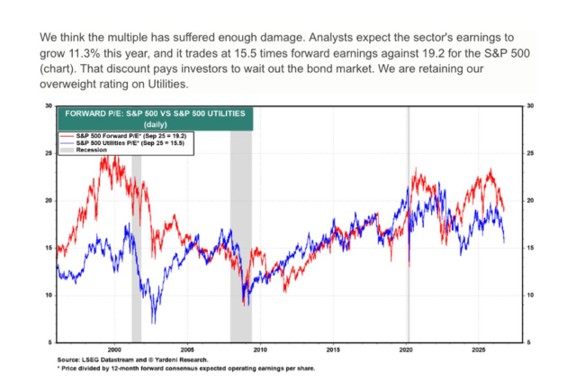
Source: Yardeni Research, LSEG Datastream. Forward P/E, S&P 500 vs S&P 500 Utilities, September 25, 2026.
Two Canadian notes.
Roughly one million mortgages renew this year at rates two to three points above where they were written five years ago, and the Bank of Canada is holding at 2.25% while the Fed hikes, which shows up first in the currency.
And the trade relationship broke this summer in a way it had not through two years of threats: CUSMA was not extended at its July review, 50% U.S. tariffs landed on about $20 billion of Canadian goods in August, and Ottawa answered with counter-tariffs in September. The way to hold Canada through an unstable relationship is to hold businesses whose customers are Canadian.
Then there is November 3.
The midterms are five weeks away and the generic ballot has Democrats ahead by seven to eight points, their strongest reading of the cycle. We have no view on who should win. What the market has to price is more mechanical.
A change in control of either chamber means two years of gridlock on fiscal policy, which bond markets have historically welcomed, and it means hearings on tariffs, on the Fed's independence and on the data centre buildout, all of which have become partisan in ways they were not a year ago. Midterm years tend to be choppy into the vote and strong after it, because the uncertainty resolves.
We are not building around that pattern. We would not be surprised by it either.
II. Rates and Stories
Morgan Housel has a line about interest rates that explains most of what happened to technology stocks this summer. When rates are low, the story side of a valuation becomes more powerful, because short-term results are not competing for attention with a risk-free return. Most of a company's value then comes from what it might achieve years from now. That is a story, and people can come up with some wild ones.
When the 10-year moved from 4.2% to 5%, the stories got cheaper. Not wrong. Cheaper.
A dollar of profit arriving in 2028 is worth less against a 5% bond than a 4.2% one, and the businesses most exposed are precisely the ones whose profits are furthest out: unprofitable AI growth names, capital-heavy infrastructure carrying rising interest costs, and anything priced on a total addressable market rather than a cash flow. The optical networking group we follow was down more than 40% from its highs by early September while every company in it that reported in August grew revenue more than 20%. The demand was fine and accelerating... The discount rate was what repriced the stocks.
This is why we spent the quarter tilting toward companies that earn their cost of capital now rather than promise to later, and why the reset condition we watch has not changed: if the major hyperscalers cut capital-spending guidance for two consecutive quarters, the demand map gets redrawn. They have not. Until then the correction is a rates story, and rates stories end when rates peak. That is the inflection point we are watching most closely, and when it comes, we intend to action on that change.
III. Technology Thoughts
On regulations
The loudest argument in the AI industry this quarter was not about chips or power. It was the head of one of the leading labs making the case, publicly, that the frontier should be paced for safety reasons. We are not qualified to referee the technical safety debate. We do have an opinion on how to think about regulating something this large, and it starts with two quotes that have nothing to do with technology.
Sebastian Junger: "Humans don't mind hardship, in fact they thrive on it; what they mind is not feeling necessary. Modern society has perfected the art of making people not feel necessary."
Elroy Dimson: "Risk means more things can happen than will happen."
The Dimson line is the one we would hand to any regulator. The catastrophic scenarios that dominate the safety conversation are things that can happen. So are a hundred better outcomes. A policy built to prevent the one worst case will also prevent most of the good ones, and it will do so invisibly, because nobody writes a headline about the cure that was not discovered.
Pacing the frontier does not remove risk. It picks which risks you take, and it tends to pick the ones that are hardest to see. It is also worth noticing that a slowdown would conveniently close every gap the leading labs are currently struggling with: products that lag their models, prices propped up by a compute shortage, and a capital base that needs revenue to catch up. A safety argument that lines up that neatly with a business need is not necessarily wrong. However, it’s awfully convenient.
The Junger line is the one we would hand to everyone else. The real risk of this technology is not that machines become dangerous. It is that people stop feeling necessary. The right policy response to that is not to slow the machines down. It is to make sure the gains show up as work, ownership and agency for the people who live near them, which is a large part of why the Alberta section of this letter exists.
The Innovator's Solution
Clayton Christensen's most durable idea is that when a product is not yet good enough, the integrated company that controls every layer wins.
The reason it wins is because it can squeeze out performance nobody else can. Once the product is good enough, the basis of competition shifts to convenience, fit and price, and the integrated leader's advantage fades. The question in AI has always been when "good enough" would arrive.
It arrived this this year, and it arrived at Meta. Muse, Meta's personal agent, became the most downloaded app in the United States within days of launch.

The model underneath it is not the best in the world. It did not need to be. It is good enough to run a personal agent, and a personal agent that holds your calendar, your accounts and your habits is far stickier than a chatbot or a coding tool. Meanwhile the leading labs, whose models are better, still do not have a consumer product with that kind of lock-in. Ralph Hodgson wrote that some things must be believed to be seen. Meta believed a good-enough model wrapped in a great product would beat a great model wrapped in a chat window and spent accordingly. Now everyone can see it.
The interesting part is what happened next. Amazon blocked Muse from shopping on its site within days. Amazon's ad business, roughly $68 billion last year, is double the profit of its retail operation, and an agent that shops on your behalf sees no ads and, on Walmart's evidence from a similar program, converts at a third the rate.
Walmart, a distant second in e-commerce, signed on the next week in the same way the second-place carriers signed on with the iPhone. Expedia joined the same day of launch. Aritzia. Shopify. PayPal.
This pattern is the one Christensen would have predicted: the incumbent with the most to protect resists, the challengers with the most to gain cooperate, and the physical asset that looks like a moat, Amazon's warehouses and vans, turns out to depend on volume the agent might slowly take away and redistribute.
Agents get a computer
The part of the Muse launch that we think matters most got the least love from the reporting media.
Meta is giving every user a virtual machine: two processor cores, eight gigabytes of memory, eight gigabytes of storage. This is a real computer running in Meta's data centres that the agent uses on your behalf.
What we’re trying to say here is that an agent is not just an AI or an extension of an LLM…
It is an AI with access to a computer, and until now the only people who had one were engineers and leading-edge adopters willing to set one up on their own. Microsoft followed within days with a redesigned Copilot that gives every enterprise user the same thing, with the controls a corporate IT department expects.
This is the bridge Thompson described in 2024, and it’s getting built in real time.
Once the agent has a computer, the apps on your phone stop being destinations and become suppliers. Thompson describes asking Muse to organize the recipes he had saved on Instagram and getting, five minutes later, a small custom app that existed only for him. That is the earliest version of interfaces generated on demand, the thing that makes glasses and watches useful as computers rather than accessories, and it explains why Meta's hardware event this month finally made sense: the devices are delivery mechanisms for the agent.
What this does to the economics is the part we as investors need to think long and hard about.
The scarce thing on the internet used to be discovery, and the companies that solved it, Google and Meta, built the best advertising businesses in history. What is becoming abundant now is the ability to get things done. What stays scarce is wanting to get things done. Whoever owns the interface where a person decides what they want, and has a computer standing by to do it, sits above every app, every retailer and every service as the gatekeeper of demand. That is why Meta and Microsoft moved this quarter, why Google is stuck between its agent and its ad business, and why Amazon said no to moving below Meta in consumer discovery.
It also explains why the market's reaction, a 13% day for ARM and a trillion-dollar market value for AMD on the theory that agents need a new fleet of CPUs. A consumer agent that runs five real tasks a day is busy about 3.5% of the time, and the infrastructure the industry is already building for it bills by the second and shuts the machine down when the task ends. The compute story is real, but we believe the new distribution story is enormous. What is required to distribute is shocking.
1. the power that runs it,
2. the physical world it must reach into, and
3. the platforms that own the moment a person decides what they want.
IV. Alberta's Time to Build
Everything we covered above is about intelligence getting cheaper and more abundant. Here is what that means for Alberta and the project in Sturgeon County.
On July 2 the Prime Minister and the Premier announced a new one-million-barrel-a-day pipeline from Bruderheim to a deepwater port in southern British Columbia. Six days later Meta announced a $13 billion AI data centre shell in Sturgeon County, its first in Canada and its largest anywhere outside the United States. One gigawatt of power, fed by a new gas plant permitted to nearly double that. Alberta's whole grid peaked at about 12,200 megawatts in 2024, so one campus is roughly 8% of the province's record demand.
For a hundred years Alberta's business model was to pull energy out of the ground, ship it somewhere else, and let someone else turn it into something more valuable. The pipeline business is the biggest version of that model, and it funds everything else. The data centre is the first serious version of a new business model.
A data centre takes natural gas, converts it to electricity, and converts the electricity into intelligence that sells globally at software margins. It is a refinery. It just refines BTUs into tokens instead of electricity, and for the first time the full cycle runs inside the province. People have talked about diversifying this economy since before either of us was born, and it almost always meant diversifying away from energy, which is why most of it failed. This is diversification downstream of energy. Our comparative advantage, cheap and abundant gas, happens to be exactly what the fastest-growing industry on earth needs most.
This opportunity has scale. The campus is anchored by the Greenlight Electricity Centre, a gas-fired plant built by Pembina, Morgan Stanley Infrastructure Partners and Kineticor. Phase one is 932 megawatts of behind the meter energy, costing roughly $4.6 billion. This project reached final investment decision in July, and is expected to be in service before 2030. Four years from decision to power, in a continent where the interconnection queue alone usually runs longer. Under Alberta's bring-your-own-power rules Meta pays the full cost of its generation, and Sturgeon County's own release says the arrangement will lower costs for ratepayers by as much as 6%. Texas froze data centre approvals in August to audit whether they were leaning on the grid. Alberta answered that problem by forcing the company to bring their own.
Some interesting Math:
One gigawatt of gas-fired load burns about 160 million cubic feet a day, which matches Pembina's own disclosure. That is a customer for Montney and Deep Basin gas that is flat, contracted, creditworthy and has no seasons, the customer the basin has spent twenty years waiting for LNG to become. If one campus becomes five, which is how hyperscalers behave once a region passes their site audit, in-province demand approaches half of what LNG Canada's first phase pulls, with no coastal pipe and no export permit. The grid operator has requests for some 16 gigawatts. Most will never be built. Enough will.
The caveats are real. Meta took most of the province's one-time grid allocation, so everyone who follows builds their own generation. Trades labour will be the binding constraint: the pipeline, the Pathways carbon capture network, the power plant and the data centre will all be bidding for the same electricians, pipefitters and power engineers in the early 2030s. One of us started his career on the tools side of this province's industrial economy and would not underestimate what that does to wages. And the whole thesis depends on the province continuing to say yes quickly.
Here is how the portfolios reflect it. Midstream and power infrastructure sit at the centre of both catalysts and are the largest expression of the theme. Gas producers with the right acreage get a new in-basin customer layered on top of LNG. Utilities, which we discussed above, are the same trade at a discount. Behind them sit the industrial land, the module fabricators and the services layer, where the least crowded opportunities live and where many of the families we work with are already exposed through their own businesses. The pattern from every prior cycle holds: the commodity gets the headlines, the infrastructure gets the early returns, the services get the multiples. And this connects back to Junger. A gigawatt campus and a million-barrel pipeline are not abstractions to the people who will build them. They are the most concrete answer available to the question of whether people will still feel necessary in an economy run partly by machines. Joel wrote a longer essay on this over the summer, Alberta, It's Time to Build, and we are happy to send it to anyone who wants it.
Mark Twain said there is no sadder sight than a young pessimist.
We are aware that this letter describes a difficult month ahead, a hawkish central bank, a trade war with our largest partner, and an industry whose leaders are debating whether to slow down. We are also aware that we live in a province that just became one of the few places on the continent building the future rather than regulating it into oblivion. On balance we think the second fact is bigger than the first three, and our portfolios are built accordingly.
Closing
The next several weeks will be about the Fed and the election, and we expect them to be noisy. We have leaned into the parts of the portfolio that pay us to wait, utilities, energy, gold and businesses with cash flow today, and we have kept our powder for the moment the 10-year tells us the tightening is done. The bridge to the next era of computing is under construction, and it is being built with concrete, gas turbines and tradespeople as much as with models and semiconductors. That is a future we are glad to own a piece of, and one we are especially glad is being built here in Alberta.
As always, we are happy to talk through your portfolio, your plan, or any of the themes above in as much detail as you want.
Thank you for your trust.
Warm regards,
Jeremy Thiessen and Joel Shackleton
Thiessen Shackleton Wealth Management
This information is not investment advice and should be used only in conjunction with a discussion with your RBC Dominion Securities Inc. Investment Advisor. This will ensure that your own circumstances have been considered properly and that any action is taken based upon the latest available information. The strategies and advice in this report are provided for general guidance. Readers should consult their own Investment Advisor when planning to implement a strategy. Interest rates, market conditions, special offers, tax rulings, and other investment factors are subject to change. The information contained herein has been obtained from sources believed to be reliable at the time obtained but neither RBC Dominion Securities Inc. nor its employees, agents, or information suppliers can guarantee its accuracy or completeness. This report is not and under no circumstances is to be construed as an offer to sell or the solicitation of an offer to buy any securities. This report is furnished on the basis and understanding that neither RBC Dominion Securities Inc. nor its employees, agents, or information suppliers is to be under any responsibility or liability whatsoever in respect thereof. The inventories of RBC Dominion Securities Inc. may from time to time include securities mentioned herein.