
Thiessen Shackleton Wealth Management
March 27, 2026
Navigating a New Market Cycle: AI, Geopolitics, and the Broadening Market
Morgan Housel has a great theory about nostalgia: It happens because the best survival strategy in an uncertain world is to overworry. When you look back, you forget about all the things you worried about that never came true. So life appears better in the past because in hindsight there wasn't as much to worry about as you were actually worrying about at the time.
There is plenty to worry about right now with a conflict in the Middle East, fracturing market leadership, and an AI revolution whose implications are still unfolding. Some of these concerns will prove warranted. Many will not. Our job is to distinguish between the two, position accordingly, and ensure your capital is structured to endure what comes next.
Executive Summary
As we close out the first quarter of 2026, the financial landscape is being shaped by three distinct but converging forces: rapid advancements in artificial intelligence, significant geopolitical friction in the Middle East, and a critical shift in stock market leadership. Managing wealth in this environment requires looking past the daily headlines to understand the structural shifts occurring underneath.
This memo provides our perspective on each of these forces and outlines the portfolio adjustments we are making for the remainder of the year.
Theme | Key Takeaway |
|---|---|
Geopolitics & Energy | Oil has surged 40%+ on the Iran conflict, yet energy equities lag — the market is pricing in a resolution. North America remains insulated; Europe and Asia bear the brunt. |
Market Structure | The Magnificent 7 have decoupled from the broader market at the most extreme level since 2023. We view this as a healthy rotation toward equal-weight strategies, quality small caps, and industrials. |
AI & Technology | AI has evolved from chatbots to reasoning models to autonomous agents. Enterprise economics justify hyperscaler capex, and integration — not raw models — is where durable value accrues. |
1. Geopolitics and Energy: The View from Alberta
The Strait of Hormuz: A Global Energy Chokepoint
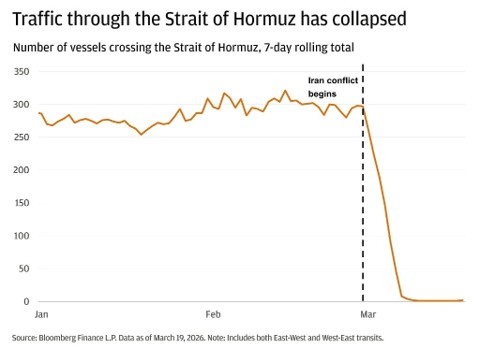
The ongoing conflict involving Iran has brought the Strait of Hormuz, a chokepoint for one-fifth of the world's oil, into sharp focus. Since the conflict began in late February 2026, vessel traffic through the strait has collapsed from approximately 300 per week to near zero, as shown in Bloomberg data through March 19, 2026. The disruption is severe and immediate.
Source: Bloomberg Finance L.P. Data as of March 19, 2026.
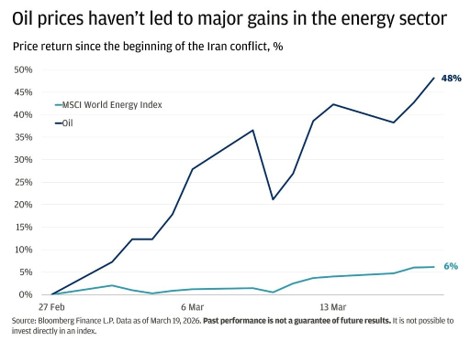
Oil prices have surged approximately 48% since the conflict began. Yet the MSCI World Energy Index has risen only ~6% over the same period. This divergence is significant: equity investors are not pricing in a permanent structural change to long-term energy revenue streams. The market's implied expectation is that the conflict will be resolved within months and that supply chains will adapt.
Source: Bloomberg Finance L.P. Data as of March 19, 2026. Past performance is not a guarantee of future results.
Historical Parallels: Oil Shocks and Equity Recovery
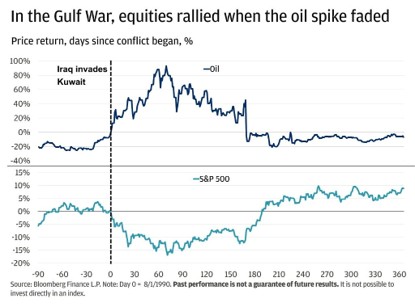
During the 1990 Gulf War, oil spiked nearly 90% after Iraq invaded Kuwait, and the S&P 500 sold off over 15% sharply, but equities recovered fully as oil prices normalized, with the index up 8–10% within a year of the conflict's onset. In 2022, crude surged 32% following the war in Ukraine, but the market was ultimately shaped more by the Fed's 400+ basis points of rate hikes than by energy alone.
Source: Bloomberg Finance L.P. Note: Day 0 = 8/1/1990. Past performance is not a guarantee of future results.
In both cases, the oil spike lasted months, not years. Well-diversified investors were rewarded for staying the course. We expect a similar pattern to play out here, though we acknowledge the risk that infrastructure damage, such as attacks on the world's largest liquefied natural gas plant in Qatar, could extend the timeline for European and Asian recovery.
North American Insulation vs. International Exposure
Operating out of Edmonton, we monitor global energy dynamics closely. The United States and Canada remain largely insulated from this specific shock due to robust North American production and geographic advantages. Most U.S. oil imports come from its neighbors, Canada and Mexico. This is not true for much of the rest of the world.
Since the conflict began, the S&P 500 and TSX has declined only ~3-5%, while international equity markets have sold off roughly 8%. European and Asian economies that depend on Middle Eastern energy supply from Saudi Arabia, Qatar, and others transiting the strait are absorbing the brunt of the disruption.
Our positioning: Should the conflict resolve in the coming months, we anticipate emerging markets and North American equities will be the primary beneficiaries. In the interim, allocations to infrastructure and gold remain prudent hedges against persistent inflation and geopolitical tail risks. Latin American crude exporters like Brazil and Mexico may see short-term revenue benefits, but limited refining capacity and fiscal costs of consumer subsidies tend to offset these gains.
2. Market Structure: The Magnificent 7 at a Crossroads
The Decoupling
For the last several years, a handful of mega-cap technology stocks — the "Magnificent 7" (Alphabet, Amazon, Apple, Meta, Microsoft, Nvidia, and Tesla) — have carried the broader market. These seven names represent approximately $20 trillion in market capitalization, roughly one-third of the entire U.S. equity market.
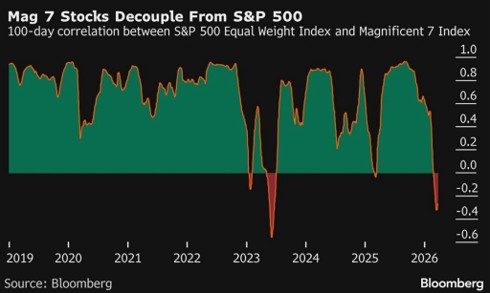
That dynamic is now fracturing. The 100-day correlation between the equal-weight S&P 500 and the Magnificent 7 index has hit its most negative level since 2023. The largest, most important stocks in the world are no longer moving in sync with the market they are supposed to be leading.
Source: Bloomberg.
This kind of divergence does not persist for long.
Either the Magnificent 7 step up and drive the next leg higher for equities, or the rest of the market is pulled lower. In 2023, a similar setup resolved with Big Tech ripping higher.
We are now back at a comparable crossroads.
The Roundhill Magnificent Seven ETF is testing former resistance levels from late 2024 - this is the decision point.
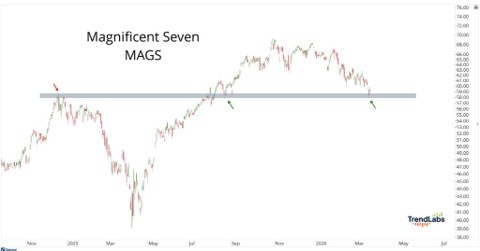
Source: TrendLabs / Optuma.
Rolling Recoveries and the Shift to Quality
We view this decoupling as a healthy structural evolution. The market is transitioning through a series of "rolling recoveries" rather than a traditional synchronized cycle. Different sectors and market segments are taking turns contributing to returns, which is a more durable foundation than having seven stocks do all the heavy lifting.
In an environment where the "easy money" era has ended, the companies that will lead are those with real pricing power, tangible earnings, and sustainable competitive positions.
We are seeing compelling opportunities in the following areas:
Area | Rationale |
|---|---|
Equal-Weight S&P 500 | Eliminates concentration risk. Captures the same 500 companies but with broader participation in the market's recovery. |
S&P 600 Small Caps | Preferred over the Russell 2000 due to earnings quality screens. Filters out unprofitable companies and targets firms with real pricing power. |
Industrials | Infrastructure spending tailwinds from reshoring and data center construction. Tangible economic exposure with pricing power. |
Critical Metals | Structural demand from energy transition (copper, lithium, rare earths) and supply chain de-risking from China. Multi-year secular theme. |
3. The AI Evolution: From Chatbots to Autonomous Agents
Despite the recent rotation away from mega-cap tech, we do not believe we are in an AI bubble. Yet.
The fundamental architecture of AI has shifted dramatically over the last three years, moving through three distinct paradigms. Each exponentially increasing both compute demand and economic utility.
Paradigm 1: ChatGPT Moment (Late 2022)
The launch of ChatGPT in November 2022 opened the world's eyes to what large language models were capable of. The technology was impressive but had two critical flaws: frequent errors and hallucinations (confidently generating false information), and the need for users to proactively know what to use them for and to verify every output. These flaws made early AI feel like a parlor trick - amazing when it worked, but not something enterprises could rely on for serious workflows.
Paradigm 2: Reasoning Models (Late 2024)
OpenAI's release of "o1" in September 2024 marked a step change in reliability. Rather than immediately outputting a stream of tokens, reasoning models self-evaluate their answers before delivering them. They consider whether a response is correct, explore alternatives, and iterate toward a better result internally. This dramatically reduced the burden on users and made AI much more dependable for knowledge work. If the brilliance of chatbots was making AI readable and useful, the brilliance of reasoning models was making AI reliable and essential.
Paradigm 3: Autonomous Agents (Late 2025)
This is the current paradigm, and it is the one that justifies the Cap-ex. When Anthropic released Opus 4.5 in November 2025 and OpenAI released Codex shortly after, what changed was not simply the model quality, it was the combination of models with software "harnesses" that control them.
Agents abstract the human away from the model entirely. A user gives instructions to an agent, which directs the model, verifies results using deterministic tools, and iterates if the output is wrong. And this is all possible without human involvement. Tasks that previously required a team working hours now execute autonomously. For verifiable use cases like software development, the results are already transformative.
The implications of this paradigm for compute demand are profound. Each agent session entails multiple calls to reasoning models, CPU compute for the harness and its tools, and dramatically increased usage driven by the step-function improvement in utility. Critically, the number of humans who need to use AI effectively for demand to skyrocket is decreasing.
A relatively small number of people with initiative can each control multiple agents, multiplying their output without requiring mass consumer adoption.
Enterprise Economics: Why Companies Will Restructure Around Agents
The most compelling near-term economic case for AI is in the enterprise market. Companies have a demonstrated willingness to pay for software that makes employees more productive. What makes agents transformative, however, is not simply making existing workers faster, it is the potential to replace hard-to-manage organizational complexity with 24/7/365 integrated digital labor.
In any large organization, a relatively small number of people actually move the needle. Their impact, however, is filtered through a massive apparatus of coordination, management, and execution. This corporate apparatus accelerates production in some ways and retards in others. Agents tilt heavily toward pure acceleration, making high-performers dramatically more impactful while eliminating coordination drag.
This creates an economic imperative that will be difficult for boards and management teams to resist. The most forward-looking organizations will restructure aggressively, not simply to cut costs but because dramatically smaller competitors built with AI from the beginning will soon present existential competitive threats.
The AI Value Chain: Integration Over Commoditization
There is a common bearish argument that AI models are rapidly commoditizing. DeepSeek in January of last year, built a competitive model for a fraction of the cost, open-source models power most startups, which would imply limited profitability for model providers.
We believe this argument underestimates the significance of the agent paradigm.
The critical insight is that what made Opus 4.5 suddenly powerful was not the model itself but the changes to the Claude Code harness that controlled it. In any technology value chain, profits flow away from modular, commoditized components and toward integrated, differentiated ones. If agents require tight integration between model and harness, then the companies building that integration specifically (Anthropic, xAI and OpenAI) are positioned to capture durable profits.
Microsoft's recent product decisions validate this thesis. The company announced a new $99-per-seat enterprise tier (E7) bundled with Copilot Cowork. This is a GUI-based agent product. Unlike Microsoft's chatbot Copilot, Cowork is not model-agnostic: it requires an integrated model-and-harness combination. Microsoft is effectively admitting that delivering a compelling agentic product means abandoning model agnosticism, which raises the possibility that models are not and will not be commodities for enterprise use cases.
4. Portfolio Positioning: Asset Allocation Adjustments
To protect and grow capital in this shifting landscape, we are considering the following asset allocation adjustments across our core investment models. The overarching philosophy is quality over momentum, breadth over concentration, and patience through geopolitical noise.
Action | Area | Detail |
|---|---|---|
Reducing | Cap-Weighted Index Exposure | Moving away from market-cap-weighted strategies where Magnificent 7 concentration creates outsized drawdown risk. The era of passive cap-weight outperformance requires reassessment. |
Adding | Equal-Weight & Quality Small Caps | RSP (equal-weight S&P 500) and S&P 600 small caps provide broader participation in the rolling recovery. Quality screens filter for real earnings and pricing power. |
Maintaining | Defensive Hedges | Gold and real assets as inflation hedges and geopolitical tail-risk protection. Infrastructure investments offer long-term yield and benefit from reshoring and data center buildout. |
Selective | AI & Technology Exposure | Targeting companies at the integration layer of the AI value chain. Companies building differentiated agent platforms and the compute infrastructure powering them, not commoditized model licensors. |
These adjustments are designed to balance offensive positioning by capturing the broadening market recovery and the structural AI opportunity with defensive prudence against geopolitical disruption and persistent inflationary pressures.
5. Key Risks and Watchpoints
Prolonged Strait of Hormuz Closure: If the conflict extends beyond what current market pricing assumes, oil prices could remain elevated, creating a sustained inflationary impulse and deeper pain for European and Asian equities. Infrastructure damage to facilities like the Qatar LNG plant or Kharg Island, could extend recovery timelines even after the Strait reopens.
Mag 7 Technical Breakdown: If the Magnificent 7 fail to hold current support levels, the cap-weighted S&P 500 could face significant downside given the 33% weighting.
AI Execution Risk: The agent paradigm is new and still evolving. Enterprise adoption timelines may be slower than the markets base case, and the competitive landscape between Anthropic, xAI, OpenAI, Google, and others remains fluid.
Monetary Policy Response: Central banks may be forced to respond to an oil-driven inflation shock with tighter policy, creating headwinds for risk assets more broadly. The Federal Reserve's response to the energy price environment is a critical unknown variable.
Geopolitical Contagion: Escalation of the Iran conflict beyond the current scope. Particularly any disruption to additional energy infrastructure or shipping lanes, could create market conditions more severe than our base case contemplates.
Client Conference Call Invitation
We will be hosting a live conference call on Thursday evening of next week to dive deeper into each of these themes and answer your questions directly.
Specifically, we will cover:
- Canadian and American monetary policy
- Iran conflict resolution scenarios and their implications for energy and emerging market positioning
- Our forward-looking thesis on AI infrastructure and which companies sit at the integration layer
- Your questions
Please watch for the formal calendar invitation from our team shortly. As always, if anything in this memo raises questions you would like to discuss before the call, please do not hesitate to reach out directly to Jeremy, Joel, Lina or Jayson.
Learn, Earn, and Invest
RBC Dominion Securities Inc.* and Royal Bank of Canada are separate corporate entities which are affiliated. *Member-Canadian Investor Protection Fund. RBC Dominion Securities Inc. is a member company of RBC Wealth Management, a business segment of Royal Bank of Canada. â / ™ Trademark(s) of Royal Bank of Canada.Used under licence. © RBC Dominion Securities Inc. 2026. All rights reserved.
This information is not investment advice and should be used only in conjunction with a discussion with your RBC Dominion Securities Inc. Investment Advisor. This will ensure that your own circumstances have been considered properly and that any action is taken based upon the latest available information. The strategies and advice in this report are provided for general guidance. Readers should consult their own Investment Advisor when planning to implement a strategy. Interest rates, market conditions, special offers, tax rulings, and other investment factors are subject to change. The information contained herein has been obtained from sources believed to be reliable at the time obtained but neither RBC Dominion Securities Inc. nor its employees, agents, or information suppliers can guarantee its accuracy or completeness. This report is not and under no circumstances is to be construed as an offer to sell or the solicitation of an offer to buy any securities.This report is furnished on the basis and understanding that neither RBC Dominion Securities Inc. nor its employees, agents, or information suppliers is to be under any responsibility or liability whatsoever in respect thereof. The inventories of RBC Dominion Securities Inc. may from time to time include securities mentioned herein.