Market Commentary
The Rate Cut Isn't Late. It's Cancelled.
How the most deflationary technology ever built became the reason money costs more.
How the most deflationary technology ever built became the reason money costs more.

Correia Private Wealth Group
September 10, 2026
A few months ago, on one of our family pilgrimages to Michaels — my kids are craft-obsessed — Asher, age six, just starting grade two, and a career Lego man, fell hard for a Metal Earth kit: the Premium Series "Silver Dragon," assembled piece by tiny piece from sheets of laser-cut steel. I told him he could have it the day he could pay for it. So he went to work. Lemonade stands, extra chores, a summer of saving — until he had put together the fifty dollars and counted it out at the till himself. He carried the box home, stared at it for two solid hours, and then called me in to build it.
The box, I should mention, is stamped "ages 14+," which in practice means "parents." Assembly requires tweezers, needle-nose pliers, and by my current estimate most of a fiscal quarter. There is no glue and there are no screws: each piece pops out of a steel sheet and locks to the next by twisting tabs the size of a grain of rice through slots you can barely see. I did the early shifts, until my wife took over one evening and — mercifully for all of us — became quietly obsessed. And somewhere around day five, it occurred to me that Asher had learned at six what the world economy is spending trillions to learn right now: raising the money is the easy part. He funded the dragon in a single summer. Building it takes tools, skill, and hours nobody budgeted for.
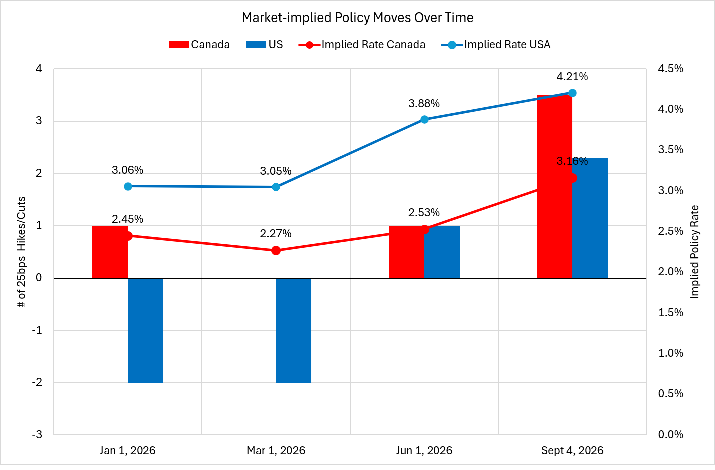
Hold that thought, because it answers the question we have heard in nearly every review meeting since 2024, usually landing somewhere between the coffee and the first chart: so — when do rates finally come down? For two years, the professional forecasters answered by penciling in the first cut and then moving it back a quarter at a time, the way one reschedules a dentist appointment. This summer, the world's bond markets lost patience and settled the question themselves. The answer was not "later."
Canada — a country that was in recession six months ago — is now priced for roughly three rate hikes by the end of next year, which is a little like being handed the bill while you are still in the recovery room. The United States is priced for two, the first considered likely by December. Japan is already raising, and its bond yields sit at their highest in a generation. Nowhere in the developed world is a cut priced with conviction. The cavalry is not running late. It has been called off.
And the culprit is the last suspect anyone would think to name: artificial intelligence — the technology that everyone, ourselves included, assumed would make everything cheaper. To see why, you have to start with a belief so old that most of us have forgotten it is a belief.
The thirty-year alibi
Every investor under sixty carries the same assumption, learned so early it feels like physics: technology is deflationary. For three decades every technology boom arrived hand-in-hand with falling inflation and falling rates. But that assumption is an artifact of the technology we happened to build. Software is weightless; artificial intelligence is made of matter — power plants, copper, turbines, poured concrete. For the first time in the modern era, a technology boom is competing with the rest of the economy for physical things, and the physical world is sending back price signals.
Follow the money into the ground
The four largest cloud companies are spending at a pace of roughly $585 billion this year, heading toward $700 billion next — technology is now over 60% of all U.S. business investment. The International Energy Agency projects global data-centre electricity consumption will more than double by 2030 — beyond what the entire nation of Japan uses today.
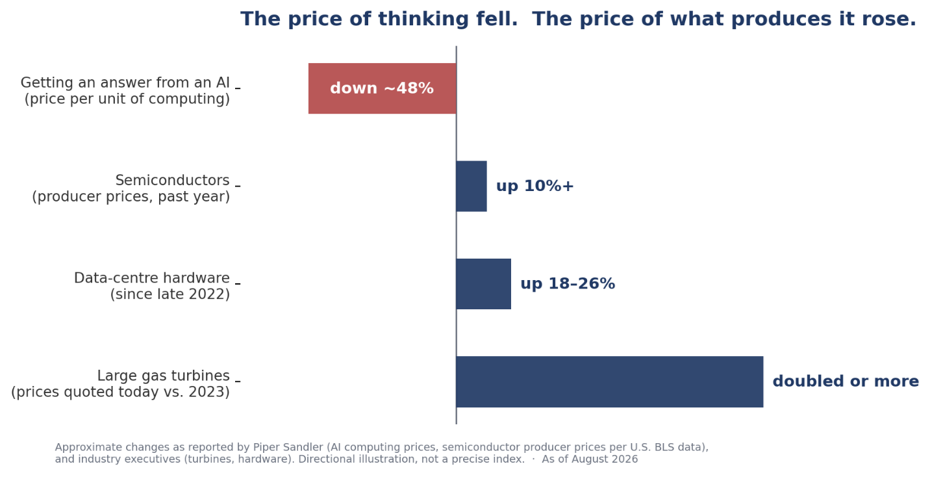
Prices are responding the way they always have. A large gas turbine now costs two to three times what it did in 2023, with a waiting list of five to seven years; transformers are quoted three years out; and semiconductor producer prices are rising at double-digit annual rates — in the industry that spent forty years defining deflation.
The paradox that proves it
The twist that fools nearly everyone: the price of intelligence itself has fallen by nearly half this year. That is not the boom fizzling — it is electricity a century ago, when cheap power electrified everything and the fortunes were made not in light bulbs but in copper, turbines, and the grid. Every time thinking gets cheaper, the world orders more of it — and every cheap ask, as our household can attest, is a claim on somebody's pliers. The cheaper intelligence becomes, the more expensive its factory gets.
The bond market did the math first
The bond market noticed first — it always does. Long-term yields track nominal income growth, and America's is running near 6% a year while the policy rate sits well below it: a setting that historically feeds booms rather than cools them. Washington's new plan to buy back long-dated bonds — $4 billion per operation, against a $5.5 trillion market — is a rounding error against that force. You cannot buy your way out of arithmetic with liquidity tools.
So why would Canada — barely out of recession — be priced for three hikes? The Bank of Canada held at 2.25% on September 2 — while flagging increased upside risks to inflation. But Canada does not set the price of money in a vacuum; it imports the world's rate regime. And Canada sells almost everything this boom devours — electricity, gas, uranium, copper, aluminum. The buildout taxes the world's borrowers and pays its suppliers — and this country, unusually, sits on both sides of the ledger. The harder question is which side of it your portfolio sits on.
How this reaches your portfolio
The fifteen years after 2008 trained investors to believe every wobble summons cheaper money. That reflex is now the biggest risk hiding inside "safe" portfolios — in long bonds bought for a rally that requires cuts, in dividend darlings priced like bond substitutes. Those assets do not need a recession to disappoint — only the script to change, and it has.
This regime is why our equity research concentrates on two kinds of businesses: those selling what the buildout cannot proceed without, and those whose earnings can grow faster than money now costs — at valuations that do not prepay the whole opportunity. On the bond side, the same discipline: an allocation should have a job beyond waiting for the next cut.
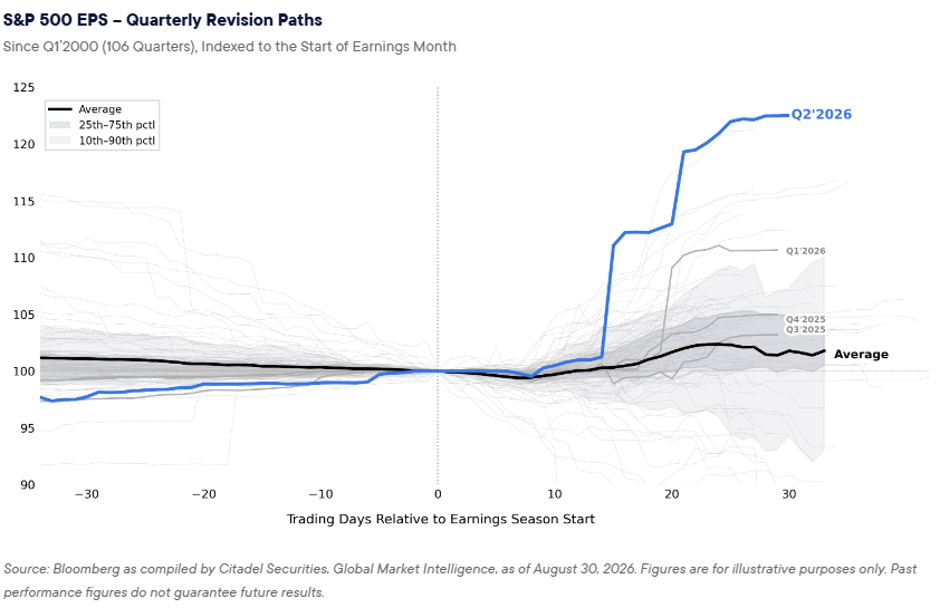
Profits, not multiples, are doing the lifting: the second quarter of 2026 traced one of the strongest earnings-upgrade paths in 106 quarters (chart below).
But isn't this just 1999 all over again?
A fair challenge, raised by several of you: this feels overdone, and the last movie ended in March 2000. But the dot-com bust announced itself as a glut — much of the fibre laid in the late 1990s sat dark for a decade — while today's system strains in the opposite direction. Gluts end buildouts; shortages extend them. Capacity is routinely sold years before it is built, and the 1990s boom died only after aggressive Fed tightening — today's tightening debate is just beginning.
Still, one place the comparison earns its keep: the financing is evolving. The first phase of this buildout was paid for out of operating cash flow; the current phase leans harder on credit. Oracle borrowed $18 billion in a single day, Meta's newest projects sit inside special-purpose vehicles, lease commitments in the hundreds of billions sit off the hyperscalers' books, and half a trillion dollars of AI-related debt issuance is expected this year. Booms run on cash first and credit later, and the credit phase is where the accidents live. This is the skeptics' strongest card and a reminder that being right about a technology is not the same as being right about its price. It does not end the thesis, but it earns a permanent place on the watch list below.
What could change the outlook
The key distinction: slower growth is maturation. Falling demand and cancelled investment would signal thesis deterioration.
Conviction is only worth having if you know what would change it. If the buildout stalls, it will be time to change course quickly — we monitor that risk weekly. What would matter:
– cuts to hyperscalers' capital-spending plans, or material downward earnings revisions;
– shortages giving way to excess capacity, collapsing lead times, or falling infrastructure prices driven by weaker demand; or
– the buildout leaning further on debt and off-balance-sheet structures rather than cash flow.
Independent of AI developments, a key macroeconomic driver is the Iranian conflict, which is keeping oil prices elevated. Higher oil prices in turn lead to higher inflation and interest rate expectations, ultimately raising the cost of borrowing for businesses.
Bringing it back to you
The last two times capital rewired the physical world at this scale — the railways of the 1880s, the electrification of the 1920s — money was not free either. Fortunes were built anyway, by investors who understood one thing: own what the buildout cannot do without, and be paid while you wait. The AI era has ended the era of free money, not the era of compounding — it has simply moved where the compounding lives. Our kitchen table teaches the same lesson nightly: the asking is free; the rewards go to whoever holds the pliers.
If you would like to discuss what this means for your own plan — or to argue with any of it, which we enjoy just as much — call us. Our goal is unchanged: to keep you ahead of the curve, not caught behind it.
Regards,
Marc Correia
P.S. — The model is nowhere near finished. My wife says Christmas. Asher remains supervisory.
References
Bank of Canada, policy rate announcement, September 2, 2026 (bankofcanada.ca). International Energy Agency, "Energy and AI" (2025) — data-centre electricity projections. Piper Sandler Macro Research: N. Lazar, "Nancy's Weekly Narrative" (Aug 23, 2026) and "Tech Pricing Power Enjoys a Tailwind From the Fed" (Aug 28, 2026); M. Kantrowitz, "Be Aware: Analysis of Past Fed Cycles May Be Misleading" (Aug 26, 2026); K. Lewis & D. Schneider, "Q&A on Bessent's Treasury Market Intervention" (Aug 26, 2026). Bloomberg data compiled by Citadel Securities, Global Market Intelligence — S. Rubner, "September Setup: The Asymmetry Has Changed" (Aug 30, 2026). Hyperscaler capital-expenditure guidance per company disclosures. Overnight-rate forward pricing as of early September 2026. Industry expert interviews on turbine, transformer and cooling supply chains. AI-related debt issuance, special-purpose-vehicle and data-centre lease structures per Bank for International Settlements analysis and press reporting (2025–26).
Disclaimer
RBC Dominion Securities Inc.* and Royal Bank of Canada are separate corporate entities which are affiliated. *Member-Canadian Investor Protection Fund. RBC Dominion Securities Inc. is a member company of RBC Wealth Management, a business segment of Royal Bank of Canada. â / ™ Trademark(s) of Royal Bank of Canada. Used under licence. © RBC Dominion Securities Inc. (2026). All rights reserved.
This information is not investment advice and should be used only in conjunction with a discussion with your RBC Dominion Securities Inc. Investment Advisor. This will ensure that your own circumstances have been considered properly and that any action is taken based upon the latest available information. The strategies and advice in this report are provided for general guidance. Readers should consult their own Investment Advisor when planning to implement a strategy. Interest rates, market conditions, special offers, tax rulings, and other investment factors are subject to change. The information contained herein has been obtained from sources believed to be reliable at the time obtained but neither RBC Dominion Securities Inc. nor its employees, agents, or information suppliers can guarantee its accuracy or completeness. This report is not and under no circumstances is to be construed as an offer to sell or the solicitation of an offer to buy any securities. This report is furnished on the basis and understanding that neither RBC Dominion Securities Inc. nor its employees, agents, or information suppliers is to be under any responsibility or liability whatsoever in respect thereof. The inventories of RBC Dominion Securities Inc. may from time to time include securities mentioned herein.
This commentary is based on information that is believed to be accurate at the time of writing and is subject to change. All opinions and estimates contained in this report constitute RBC Dominion Securities Inc.'s judgment as of the date of this report, are subject to change without notice and are provided in good faith but without legal responsibility. Interest rates, market conditions and other investment factors are subject to change. Past performance may not be repeated. The information provided is intended only to illustrate certain historical returns and is not intended to reflect future values or returns.